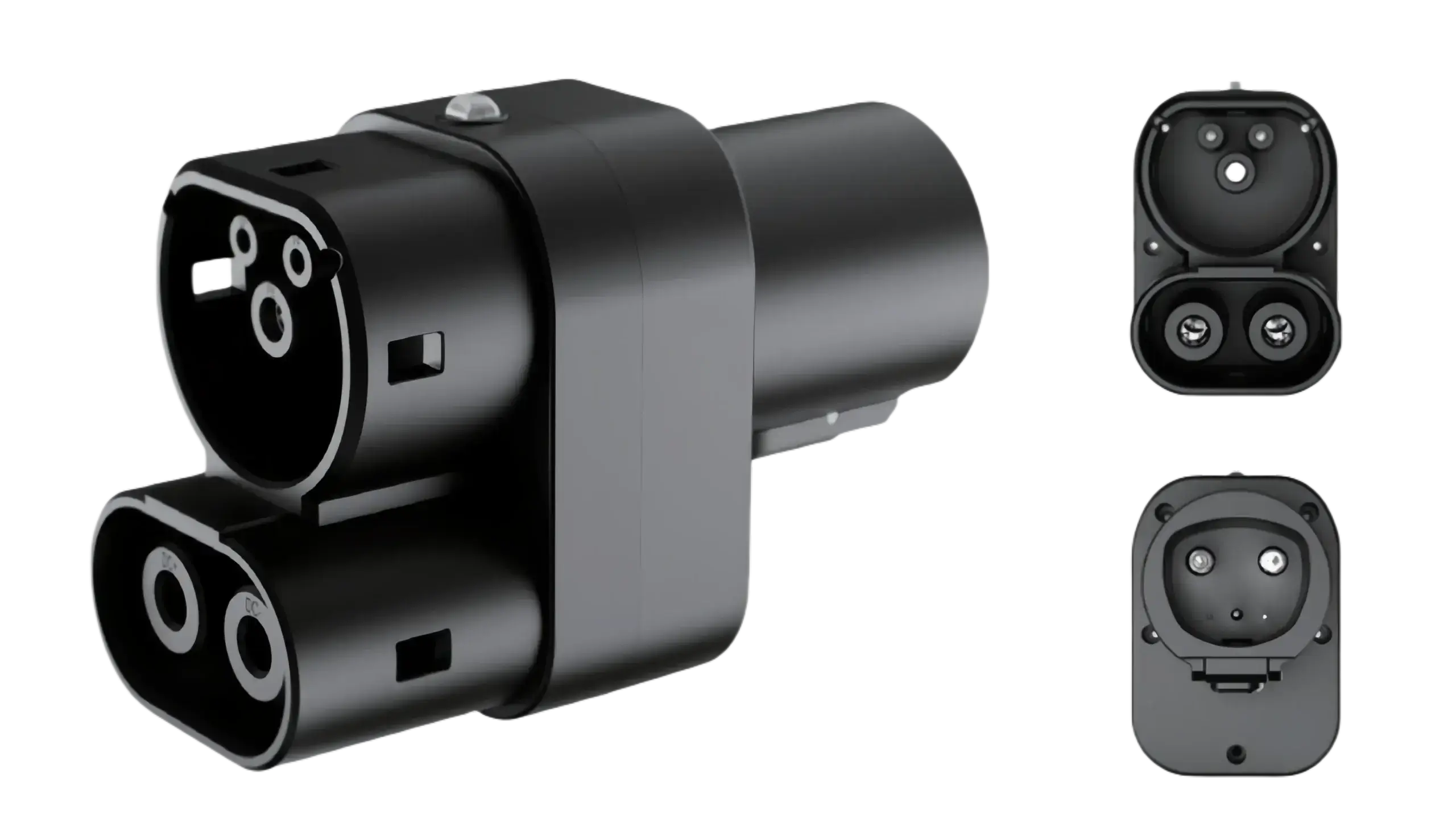
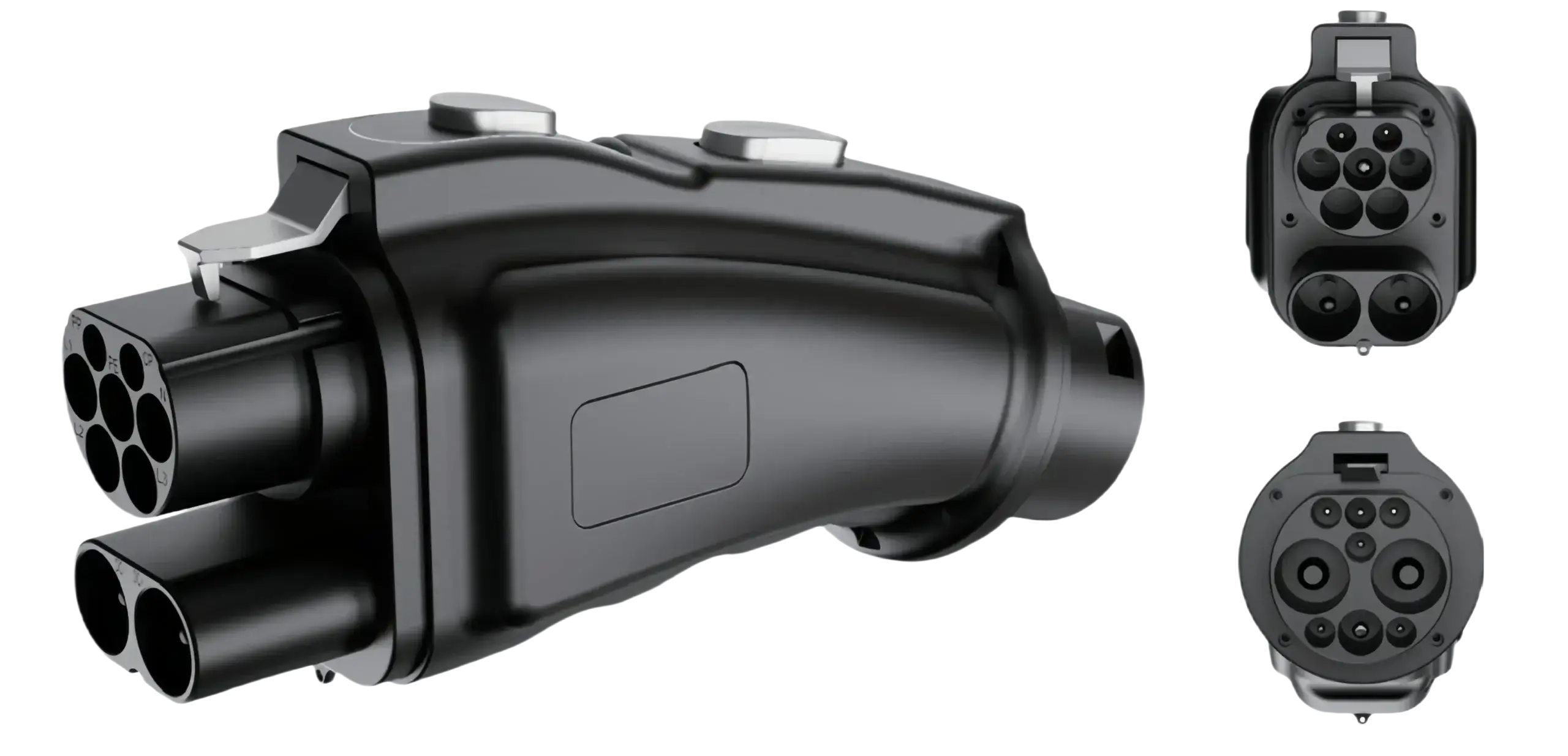
EV charging standards split by region. North America is converging on NACS, the connector now standardized as SAE J3400, while Europe, Australia, and much of Asia, Africa, and Latin America run on CCS2. When a vehicle built for one standard meets chargers built for the other, the fix is not a new car or a new charging network. It is a dedicated EV charging adapter, and the NACS to CCS2 adapter is the version that matters most for cross-standard charging.
Yes. A NACS-equipped EV can charge on CCS2 chargers when you use a NACS to CCS2 adapter that matches the charging mode. The adapter bridges the NACS vehicle inlet and the CCS2 station connector, carries AC Level 2 charging, and carries DC fast charging where the vehicle itself supports the CCS communication protocol. Direction matters: a NACS to CCS2 adapter serves NACS vehicles on CCS2 stations, not the other way around.
This guide explains how the adapter works, what separates the two standards, who actually needs one, and how to choose a safe unit for commercial use.
What is a NACS to CCS2 adapter?
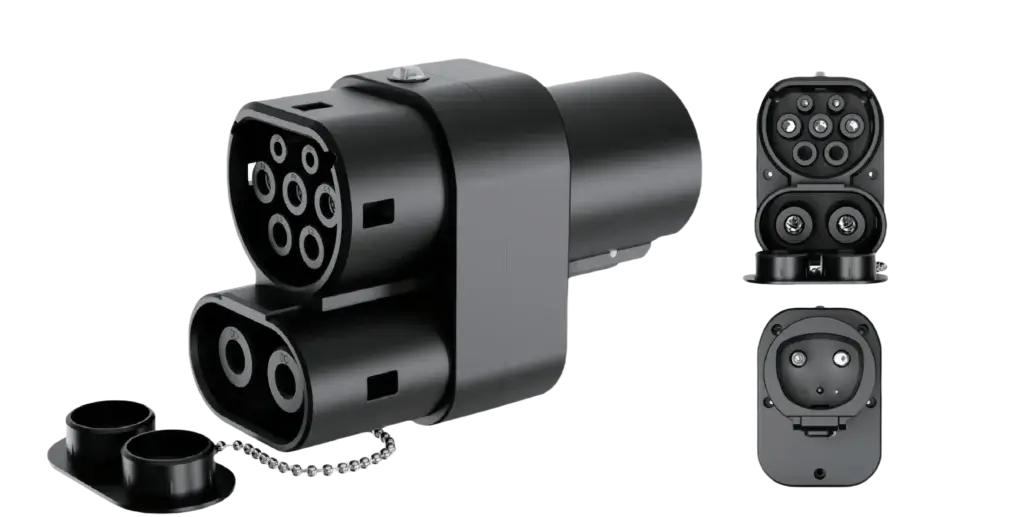
A NACS to CCS2 adapter is a connector bridge with a NACS plug on one end and a CCS2 interface on the other. It lets a vehicle with a NACS charging inlet draw power from CCS2 charging stations. Commercial versions come in DC-only and DC+AC formats, with typical ratings up to 250A DC and 80A AC at 1000V DC.
Two directions, two products
Search results blur this, so it is worth stating plainly. An NACS to CCS2 adapter serves an NACS vehicle on a CCS2 station. A CCS2 to NACS adapter does the reverse: it serves a CCS2 vehicle on a NACS station. The pin layouts, protocols, and use cases differ, and ordering the wrong direction is the most common purchasing mistake in this category. Before you buy, confirm the vehicle inlet standard first, then the charger standard, then pick the adapter that sits between them.
DC-only and DC+AC versions
DC-only adapters handle fast charging at public CCS2 stations. DC+AC adapters add AC Level 2 support, so the same unit works at highway fast chargers and at destination or wallbox stations. Fleets and rental operators usually standardize on the DC+AC version because one adapter covers every charging scenario instead of two.
Can a NACS EV charge on a CCS2 charger?
Yes, if three conditions line up: the adapter direction matches the vehicle, the vehicle supports the CCS communication protocol for DC sessions, and the station authorizes the vehicle’s handshake. Miss any one of these and the session will not start, even though the plugs fit together.
The three conditions that decide whether it works
- Correct adapter direction. The adapter’s vehicle-side plug must match the car’s inlet, and the station-side interface must match the charger.
- Vehicle protocol support. DC fast charging over CCS2 relies on power line communication between car and charger. A NACS inlet does not automatically mean the vehicle can run a CCS DC session. Most NACS vehicles from 2025 onward support it; older or gray-import vehicles may not. Check the vehicle specification before promising DC speeds.
- Station authorization. The network must recognize and authorize the vehicle. Payment integration and access rules live at the network level, not inside the adapter, so a matching plug is necessary but not always sufficient.
Do I need a CCS to NACS adapter?
This question points to the reverse product. A CCS to NACS adapter serves a CCS2 (or CCS1) vehicle that needs to charge on NACS stations. If your vehicle carries a CCS2 inlet and your chargers are NACS, that is the adapter you need. If your vehicle has an NACS inlet and your chargers are CCS2, you need the NACS to CCS2 version covered in this article. The practical rule: match the adapter name to the vehicle inlet, because the inlet standard always comes first.
NACS vs. CCS2: how the two standards differ
NACS and CCS2 are different connector standards from different regions. NACS is the compact North American connector that carries AC and DC through the same contacts. CCS2 is the European and global export standard that extends a Type 2 AC interface with two large DC pins. Neither fits the other without an adapter.
| Feature | NACS (SAE J3400) | CCS2 |
|---|---|---|
| Primary regions | United States, Canada, Mexico | Europe, the UK, Australia, New Zealand, India, the Middle East, much of Africa, and Latin America |
| Connector design | Compact 5-pin body; AC and DC share the same contacts | Type 2 AC interface plus two DC pins below |
| AC charging | Yes, through the same port. | Yes, through the Type 2 upper section |
| DC fast charging | Yes, through the same port. | Yes, through the combined DC pins |
| Typical commercial DC power | 250 kW class today, higher on the newest hardware | 350 kW class deployed with liquid-cooled cables |
| 2026 market position | Dominant on new North American vehicles and stations | Required on public DC chargers across the EU |
On adoption, the gap is closing fast in North America. Connector surveys in early 2026 put NACS at roughly 48% of North American DC fast-charging connectors, ahead of CCS1 (per published connector-market reports, checked 29 September 2026). In Europe, CCS2 holds a regulatory position: EU rules require CCS2 compatibility on publicly accessible DC charging points, so the installed base keeps expanding.
How NACS became an open standard
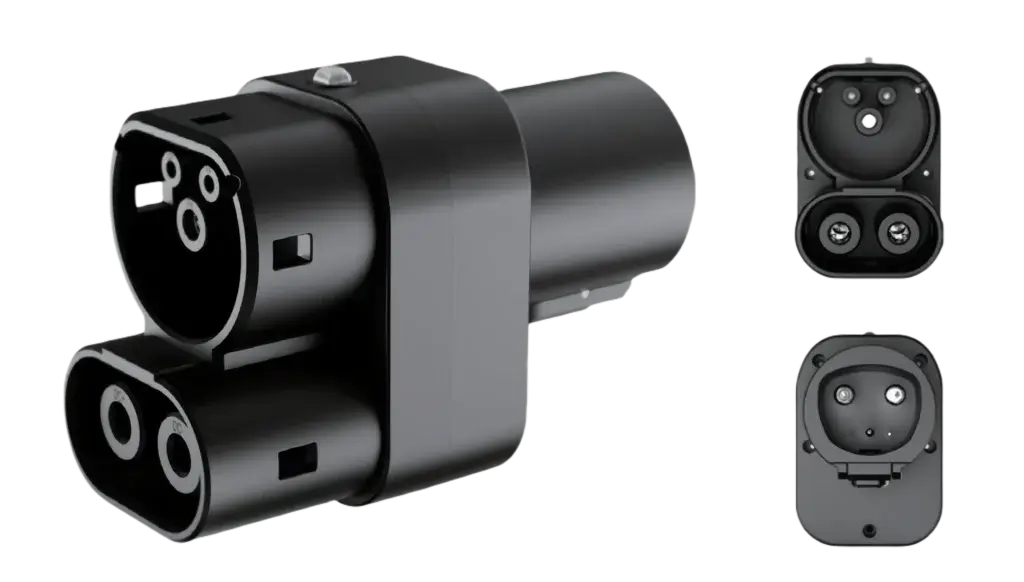
NACS began as a proprietary design and became an open one. SAE International published it as SAE J3400, a standard covering conductive charge transfer of DC or single-phase AC through the same two main current-carrying contacts. That open status is why nearly every major automaker now ships native NACS inlets on 2025-and-later North American models, and why adapter demand keeps growing on both sides of the Atlantic.
Are Type 2 and CCS2 the same?
No. Type 2 is the AC charging interface defined under IEC 62196, used across Europe for wallboxes and public AC stations. CCS2 builds on it: it keeps the Type 2 pin layout for AC and adds two DC contacts below for fast charging. Every CCS2 inlet accepts a Type 2 AC session, but a plain Type 2 connector cannot deliver DC power. The two terms describe different layers of the same system, which is why the confusion shows up so often in adapter searches.
AC vs DC charging with an NACS to CCS2 adapter
A NACS to CCS2 adapter can carry both AC and DC power, but only the DC+AC version supports both modes. Charging speed always follows the weakest link in the chain: the station’s output, the vehicle’s accepted rate, and the adapter’s current rating. The adapter never adds speed. It can only carry what the station and vehicle negotiate.
On AC, the vehicle’s onboard charger sets the ceiling. A session at a wallbox usually lands between 7 kW and 22 kW, depending on the car, regardless of the adapter. On DC, the station and vehicle negotiate the current directly, and a compatible session at a highway charger typically restores 10 to 80 percent in 20 to 40 minutes at suitable power levels.
Typical commercial ratings for this adapter class, per our product listings, look like this:
| Parameter | Typical value |
|---|---|
| DC current | Up to 250A |
| AC current | Up to 80A |
| DC voltage | Up to 1000V |
| Ingress protection | IP54 (mated) |
| Operating temperature | -30°C to +50°C |
| Conductors | Copper alloy, silver-plated |
| Housing | Flame-retardant thermoplastic |
One detail matters for fleet procurement: the adapter’s current rating caps the session. A 250A DC adapter will not limit most vehicles today, but if a future vehicle and station negotiate more current than the adapter is rated for, its temperature monitoring will curtail or stop the session. That looks like a fault and is actually a protection feature.
Who actually needs this adapter?
Four buyer groups account for most demand: importers and owners of NACS vehicles living in CCS2 regions, cross-border rental and lease fleets, hospitality and charging-site operators serving visiting NACS vehicles, and distributors supplying all three. If a NACS inlet will ever meet a CCS2 station in your market, this adapter belongs in your catalog.
- Imported NACS vehicles. North American and Japanese-spec NACS vehicles relocated to Europe, Australia, or New Zealand face a CCS2-only public network. An adapter converts a stranded vehicle into a usable one.
- Rental and corporate fleets. Mixed-standard fleets crossing regions need one accessory that keeps every vehicle chargeable, and DC+AC units avoid carrying two adapters.
- Hotels, parking operators, and public charging sites. Properties in tourist-heavy CCS2 regions that accommodate visiting NACS vehicles keep guests charging on-site instead of sending them elsewhere.
- Distributors and installers. As NACS inlets spread through 2025-and-later vehicles, European stockists are adding this category ahead of demand.
For procurement teams sourcing a DC unit, the NACS to CCS2 DC Adapter on our product pages lists full ratings, stock status, and OEM/ODM options for white-label supply.
How to choose a safe NACS to CCS2 adapter
Check five things before ordering: current and voltage ratings, DC or DC+AC support, ingress protection, thermal protection, and the supplier’s OEM and certification capability. An adapter that passes high current without temperature monitoring is the biggest safety risk in this category.
| Checklist item | What to look for | Why it matters |
|---|---|---|
| Current rating | 250A DC / 80A AC class for commercial use | Covers today’s negotiated sessions without curtailment |
| Charging mode | DC+AC for fleets, DC-only for highway use | AC-only units cannot run fast-charging sessions. |
| Ingress protection | IP54 or better when mated | Outdoor stations mean rain, dust, and road spray. |
| Thermal protection | Built-in sensor with automatic cutoff | Stops overheating before it becomes a fire risk |
| Materials | Silver-plated copper contacts, flame-retardant housing | Lower contact resistance and longer service life |
| Supplier capability | OEM/ODM support, warranty, ready stock | Matters for distributors building a private-label line |
Two mistakes account for most returns and complaints. The first is buying an AC-only adapter and expecting DC fast charging; the mode has to be built in. The second is assuming the adapter itself grants network access. The adapter handles the physical and electrical bridge, while authorization, payment, and software compatibility remain questions for the vehicle and the charging network.
Daily handling is simple but worth training drivers on. Connect the station plug to the adapter first, then plug the adapter into the vehicle, and end the session before unplugging in reverse order. Store the adapter dry and inspect the pins periodically, because dirt or corrosion on silver-plated contacts shows up as heat long before it shows up as a failed session.
FAQ
Does a NACS to CCS2 adapter reduce charging speed?
Not below the rates the station and vehicle negotiate, as long as the adapter’s current rating covers the session. A 250A DC unit will not slow a session that stays under that limit. If the negotiated current exceeds the adapter’s rating, thermal protection curtails or stops the session, which looks like a speed problem but is a protection feature working as designed.
Can I use an NACS to CCS2 adapter on a Tesla Supercharger?
Usually not, and you normally do not need to. Superchargers in North America deliver NACS natively, so a NACS vehicle plugs in directly. Superchargers in Europe deliver CCS2, and European-spec vehicles already carry a CCS2 inlet. The NACS to CCS2 adapter exists for NACS-inlet vehicles facing third-party CCS2 networks, which is a different scenario from Supercharger access.
Are NACS to CCS2 adapters legal in Europe?
Adapters are legal to sell and use, but the vehicle must comply with local type-approval rules, and the charging session must respect station terms. For commercial deployment, source adapters with documented ratings and, where your market requires it, certification support from the supplier. Station operators should confirm their network’s policy on adapter use before promoting it to customers.