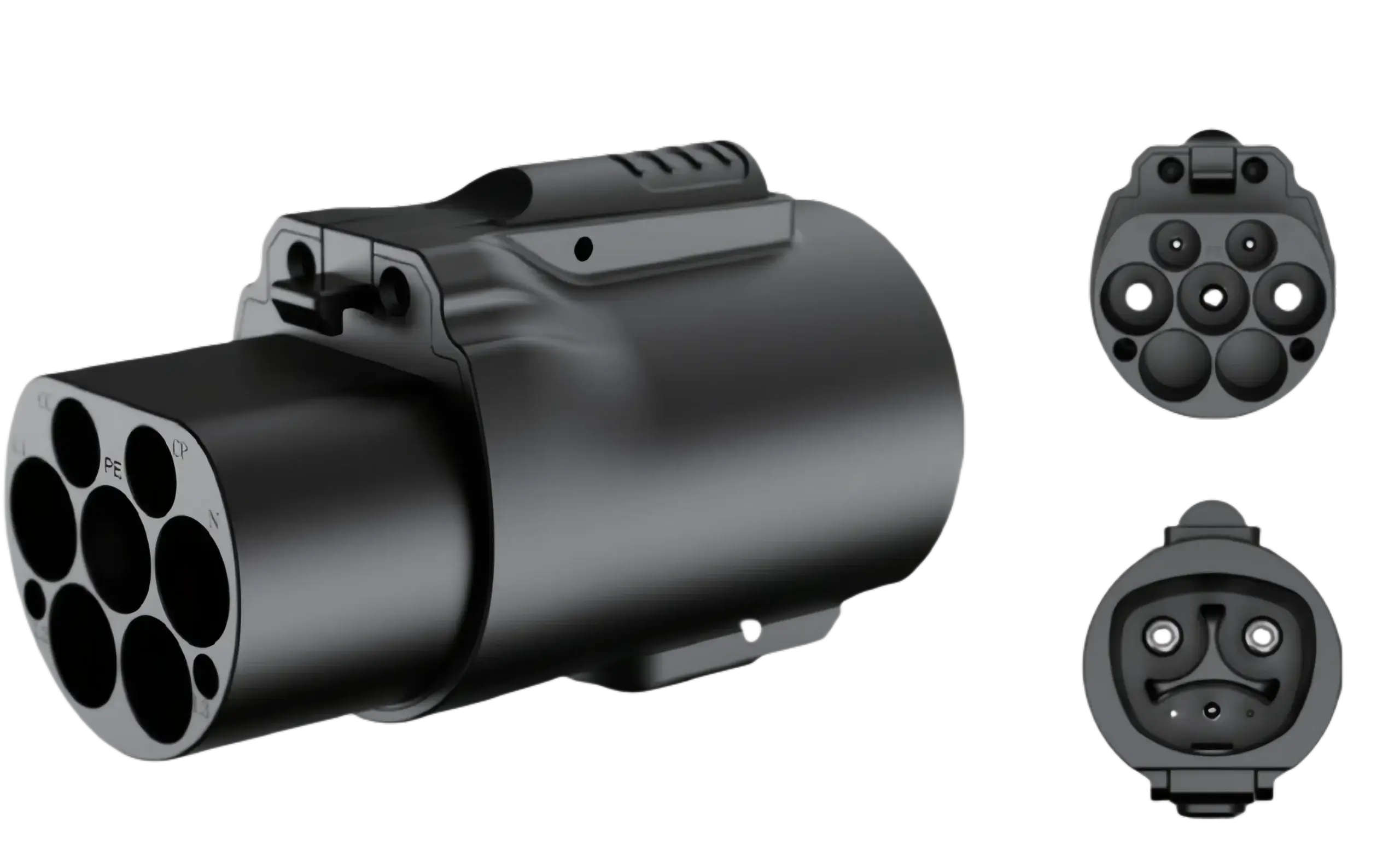
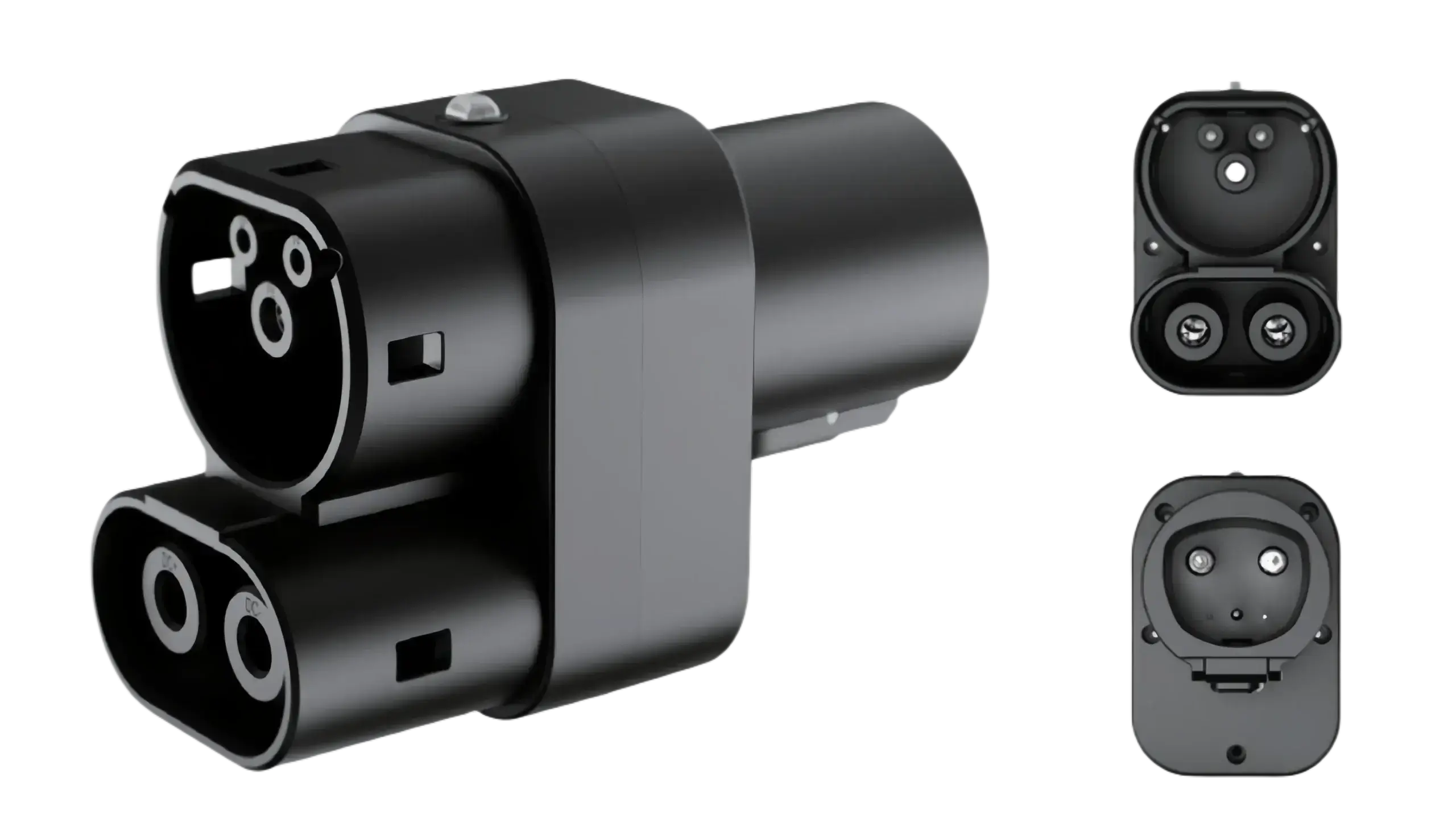
Electric vehicles sold in mainland China use the GB/T charging standard, while Tesla’s North American Charging Standard (NACS) now dominates charging hardware across North America and is spreading to other markets. The two systems use different connector shapes, pin layouts, and communication signals, so a Chinese-standard EV cannot simply plug into a Tesla charger. For exporters, importers, fleet operators, and owners who move vehicles between regions, that mismatch raises a practical question: is there a safe, compliant way to bridge the two systems? The NACS to GB/T adapter exists to answer exactly that need.
Yes, a Chinese EV can use certain Tesla chargers with a NACS to GB/T adapter, but only for AC charging. The adapter lets a GB/T-equipped vehicle draw power from Tesla AC equipment such as Destination Chargers, Wall Connectors, and Mobile Connectors. It cannot unlock Tesla DC Superchargers, because those rely on a different DC communication protocol that a simple passive adapter cannot translate.
This guide explains what the adapter is, separates the NACS standard from Tesla’s charging hardware, and shows how to select a compatible and certified unit.

What Is a NACS to GB/T Adapter?
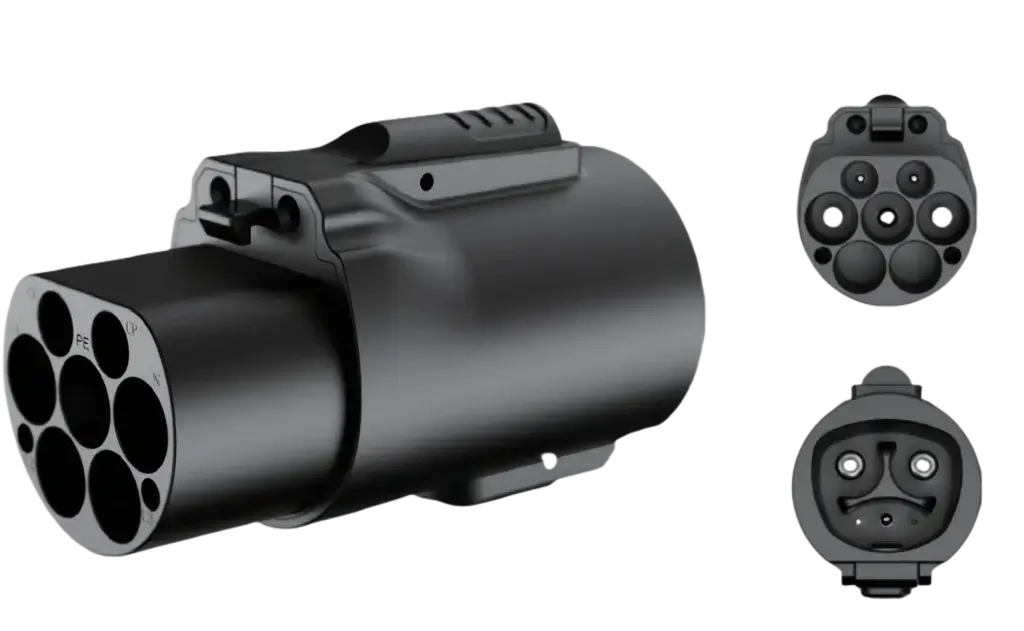
A NACS to GB/T adapter is a connector that changes the physical interface between a NACS (SAE J3400) charging plug and a GB/T 20234.2 AC vehicle inlet, allowing a Chinese-standard EV to charge from compatible Tesla AC equipment.
The direction matters. In this configuration, the charging source carries a NACS plug and the vehicle has a GB/T AC inlet. The adapter does not generate or convert power. It reroutes the conductors to the correct pins and preserves the control signal so both sides can communicate. As a result, the actual charging speed always depends on the power the source can deliver, the cable path, and the onboard charger inside the vehicle, not on the adapter alone. Adapters in this family are part of a broader range of Charging Adapter products built for cross-standard compatibility.
The Two Connectors It Bridges
The two interfaces differ in shape, pin count, and electrical behavior.
| Feature | NACS / SAE J3400 | GB/T 20234.2 (AC) |
| Connector shape | Compact, single-body | Larger, seven-pin |
| Charging type | AC and DC through shared pins | AC only |
| Typical AC power | Up to 11.5 kW | Up to 7.4 kW single-phase, or 22 kW three-phase |
| Primary region | North America | Mainland China |
What the Adapter Enables and What It Does Not
- Enables AC charging from Tesla Destination Chargers, Wall Connectors, Universal Wall Connectors, and Mobile Connectors.
- Supports Level 2 sessions that a GB/T vehicle can accept through its onboard charger.
- Does not enable DC fast charging, and does not work with Tesla Superchargers.
- Does not convert voltage or increase the power available at the source.
A dedicated NACS to GB/T Adapter is engineered specifically for this AC path.
Are NACS and Tesla Chargers the Same?
No. NACS is a connector standard, while the phrase “Tesla charger” usually refers to the physical charging hardware and the network that Tesla operates. The two overlap because Tesla created NACS and uses it across its own equipment.
Understanding this distinction prevents a common mistake. People often assume that any product labeled NACS belongs to Tesla, or that every Tesla-branded charger behaves the same way. Neither is true. NACS defines the plug and the electrical interface. Tesla’s chargers are the machines that deliver power, and they come in both AC and DC versions with very different capabilities.
NACS as an Open Standard (SAE J3400)
NACS began as Tesla’s proprietary connector in 2012. Tesla opened the design to other manufacturers in 2022, and in 2023 the connector was standardized by SAE International as SAE J3400. That step turned a single-company plug into a published, open specification that any manufacturer can adopt. Today NACS is best understood as a connector standard that supports both AC and DC charging through one compact port.
Tesla Charging Hardware vs the NACS Connector
Tesla operates several types of charging equipment, and only some are relevant to a GB/T vehicle.
| Equipment | Current type | Typical power | Relevant to GB/T EVs |
| Supercharger | DC fast charging | 150 kW to 350 kW | No |
| Destination Charger | AC Level 2 | Up to 11.5 kW | Yes, with an adapter |
| Wall Connector | AC Level 2 | Up to 11.5 kW | Yes, with an adapter |
| Mobile Connector | AC Level 1 or 2 | Up to 7.7 kW | Yes, with an adapter |
Can Chinese EVs (GB/T) Use Tesla or NACS Chargers?
It depends entirely on the charger. A GB/T vehicle can use Tesla AC chargers with a certified NACS to GB/T adapter, but it cannot use Tesla DC Superchargers.
This split is the single most important fact in this article. Many buyers assume that one adapter unlocks the entire Tesla network. In reality, AC and DC charging use different electrical paths and different communication protocols, and that difference decides what is possible.
Tesla AC Chargers: Yes, With the Right Adapter
Tesla’s AC equipment delivers alternating current to the vehicle, which the onboard charger converts to DC before it reaches the battery. Because this path relies on a relatively simple control signal, a passive adapter can bridge it reliably. With a correct adapter, a GB/T vehicle can charge at Destination Chargers, Wall Connectors, and Mobile Connectors. Current ratings of 32A and 48A are common, corresponding to roughly 7.6 kW and 11.5 kW where the source and the onboard charger support them.
Tesla DC Superchargers: Why GB/T EVs Cannot Use Them Today
DC fast charging is a different story. At a Supercharger, the charger and the vehicle negotiate power delivery directly over a digital protocol, and the charger itself produces the high-voltage DC current. A GB/T vehicle speaks the Chinese DC protocol, while a Supercharger expects the NACS DC protocol. A passive adapter cannot translate that conversation, and there is currently no certified, compliant adapter that lets a GB/T DC vehicle charge at a Tesla Supercharger. Even in North America, non-Tesla drivers who use Superchargers rely on native NACS ports or manufacturer-approved adapters for their own standard, not on a universal fix. The U.S. Department of Energy’s Alternative Fuels Data Center documents how charging levels and connector types differ, which is why compatibility must always be checked per vehicle and per station. For reference, products such as a NACS-CCS1 DC Adapter show how DC bridging is handled for other connector families, and why such solutions are standard-specific.
| Tesla charger | Charging type | Can a GB/T EV use it? | What is required |
| Supercharger | DC fast | No | Not achievable with a passive adapter |
| Destination Charger | AC Level 2 | Yes | NACS to GB/T AC adapter |
| Wall Connector | AC Level 2 | Yes | NACS to GB/T AC adapter |
| Mobile Connector | AC Level 1 or 2 | Yes | NACS to GB/T AC adapter |
Can You Use Any Tesla Charger With an Adapter?
No. An adapter only solves the physical fit and, for AC, the control signal. It cannot convert DC fast-charging protocols, so the idea that any adapter works with any charger is not realistic.
AC vs DC: Why the Distinction Matters
AC charging passes current through the vehicle’s onboard charger, an electronic component designed to accept a range of AC inputs. This makes AC bridging more forgiving, and adapters in this category are widely used. DC charging bypasses the onboard charger and depends on a real-time digital handshake between the station and the battery management system. Because that handshake is standard-specific, a DC adapter must be engineered for one exact pair of standards, and it must be approved for that use.
Certified vs Uncertified Adapters
Not every adapter on the market is safe. A certified unit is tested for current capacity, temperature rise, insulation, and mechanical durability.
- Look for recognized marks such as CE, TUV, or UL.
- Check the rated current and confirm it matches your source and vehicle.
- Confirm an ingress protection rating suitable for outdoor use.
- Verify locking mechanisms that prevent accidental disconnection.
- Avoid products with no test data, unclear ratings, or misleading DC claims.
Uncertified adapters can overheat, arc, or damage the charging system, and they may void a vehicle warranty.
How the NACS to GB/T Adapter Works
For AC charging, the adapter maps the power and earth conductors from the NACS plug to the GB/T AC inlet and passes the Control Pilot signal so the vehicle and the charger can agree on the available current.
Electrical Pin Mapping and Signaling
NACS carries line, neutral, protective earth, and a Control Pilot conductor. GB/T AC uses a seven-pin layout with comparable functions plus a connection-confirm contact. Inside the adapter, the conductors are routed to their matching counterparts, and the Control Pilot path is preserved so the vehicle’s onboard charger reads the available current correctly. China’s interface requirements are defined in the GB/T 20234 series published on the national standards platform.
Key Technical Specifications
Specifications vary by model, but a well-built adapter typically shares these characteristics.
| Parameter | Typical value |
| Charging type | AC Level 2 only |
| Rated current | 32A to 80A, model dependent |
| Rated voltage | Up to 250V AC, single-phase |
| Operating temperature | -30 degrees Celsius to +50 degrees Celsius |
| Ingress protection | IP54 or higher |
| Flame rating | UL94 V-0 housing |
| Contact resistance | 1 milliohm or lower |
| Locking | Mechanical lock at the vehicle side |
Can Non-Tesla EVs Use Tesla Chargers?
Yes. In North America, many non-Tesla EVs can charge at Tesla equipment either through a native NACS port or an approved adapter, and a growing portion of the Supercharger network is open to them.
There are two main paths. Vehicles built with a native NACS port plug in directly with no adapter. Vehicles with an older CCS1 port use either a built-in dock adapter at select stations or a dedicated CCS1 to NACS adapter. Availability varies by location and by manufacturer approval, so drivers should confirm access before relying on it.
A GB/T vehicle is a separate case. It does not share the CCS1 interface, so the general non-Tesla pathway does not apply to it, and its realistic option remains AC charging through a NACS to GB/T adapter. This is why cross-standard planning matters for imported or exported Chinese EVs.
How to Choose the Right NACS to GB/T Adapter
Match the adapter to your charging source, confirm it is rated for AC only, and verify certification and environmental protection before you buy.
Use this checklist:
- Confirm the direction. The adapter must accept a NACS AC source and connect to a GB/T AC inlet.
- Check the current rating and match it to both the source and the vehicle’s onboard charger, whether 32A, 48A, or higher.
- Verify certification. Prefer units tested to CE, TUV, or UL, with clear test documentation.
- Review protection ratings. Choose IP54 or better for outdoor use, and a UL94 V-0 housing for flame resistance.
- Check the operating temperature range against your climate.
- Confirm that the locking design prevents accidental disconnection.
- Ask about OEM and customization options if you are sourcing for a fleet or a project.
For organizations buying in volume, working with a supplier that provides full test data and customization reduces both safety and support risk.
Related Adapter Solutions
Because charging directions are not symmetric, most cross-standard needs require dedicated, direction-specific adapters rather than one universal product.
Common needs include:
- NACS to CCS2, for NACS vehicles that must use CCS2 stations, explained in this guide to a NACS to CCS2 Adapter.
- GB/T to CCS2, for Chinese EVs charging on European DC networks.
- GB/T to Type 2, for Chinese EVs on European AC networks.
- GB/T to NACS, the reverse direction, for GB/T vehicles that need to connect to a NACS-style source.
- CCS1 to NACS, for older North American EVs using Superchargers.
Choosing the correct direction first prevents the most common compatibility failures.
FAQ
Can a Chinese EV use a Tesla Supercharger in North America? No. Superchargers deliver DC fast charging through a protocol that a GB/T vehicle does not share, and no certified adapter currently bridges that DC path. A GB/T EV can only use Tesla AC equipment such as Destination Chargers and Wall Connectors, with the appropriate AC adapter.
Does a NACS to GB/T adapter work in both directions? No. Adapters are direction-specific. A NACS to GB/T adapter accepts a NACS source and connects to a GB/T inlet. Charging a NACS vehicle from a GB/T source, such as a Tesla using a GB/T station in China, requires a separate and differently configured adapter.
What charging speed can a NACS to GB/T adapter deliver? The adapter itself does not set the speed. The result depends on the source output, the cable path, and the vehicle’s onboard charger. In typical AC setups, a 32A source yields roughly 7.6 kW and a 48A source yields roughly 11.5 kW, so real charging time is best estimated from the weakest link in that chain.