
Navigating the market for electric vehicle diagnostic tools can feel a bit like walking through a minefield. There is an overwhelming number of options, ranging from cheap plastic dongles to heavy industrial suitcases. For any technician or serious DIY enthusiast, having a reliable Testeur de chargeur de VE is non-negotiable. It is the only way to truly know if a station is safe before plugging in a valuable vehicle.
It is often observed that professionals start with a cheap unit, only to replace it six months later when the toggle switches fail. The best equipment manages to balance durability with usability—because nobody wants to be reading a complex manual while standing in the pouring rain.
Essential criteria for a quality EV Charger Tester
Before listing the top picks, it is worth looking at what actually matters in the field. A shiny screen is nice, but does it work when your hands are greasy?
- Simulation Capability: The device must accurately mimic the CP (Control Pilot) and PP (Proximity Pilot) states. It has to trick the station into thinking a real car is there.
- Portabilité : Some units are just too bulky. If it doesn’t fit easily in the van’s rack, it becomes a nuisance.
- Safety Ratings: We are dealing with high voltage. If the casing feels flimsy, it is a safety hazard.
Top 5 EV Charger Tester recommendations
Here are the five units that currently stand out in the market, ranging from established industry standards to highly efficient specialized tools.
The established industry standards
- Fluke FEV300: This is the adapter most electricians recognize immediately. It is rugged, heavy, and reliable. However, it requires a separate multifunction tester to give you the readouts, acting purely as an interface.
- Megger EVCA210: A direct competitor to the Fluke. It is well-loved for its compact design and the fact that it usually comes with a variety of patch leads, making it versatile right out of the box.
The specialized and versatile solutions
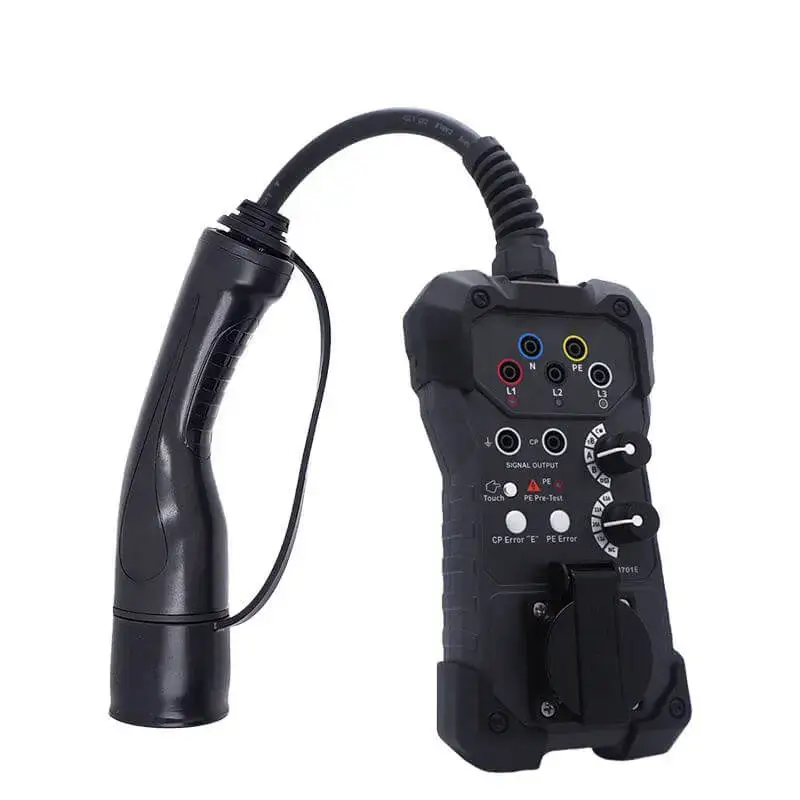
- Professional Portable EVSE Tester: This unit has gained significant traction recently. It is designed specifically for mobility. Unlike the adapters that need extra gear, this is often a more integrated solution. It feels substantial in the hand but isn’t so heavy that it drags you down. It is excellent for quick, accurate fault finding without setting up a full test bench.
- EV Charger Tester Box: This is the heavy-duty option. As the name suggests, it is a boxy, robust unit designed for rigorous simulation. It is often observed in workshop environments or for commissioning new sites where the unit might be knocked around. It provides a stable platform for testing all charging states (A through D).
- Seaward EV100: A great option for those who want automation. It simplifies the testing sequences, making it harder to miss a step, though some old-school techs prefer the manual control of the other units.
Comparing the specifications
| Nom du produit | Best Application | Portabilité | Durability Feel |
|---|---|---|---|
| Testeur professionnel portable d'EVSE | Field Diagnostics | Haut | Excellent |
| Boîte de test pour chargeur EV | Installation/Bench | Moyen | High (Rugged) |
| Fluke FEV300 | Compliance Testing | Moyen | Industrial |
| Megger EVCA210 | General Electrical | Haut | Haut |
| Seaward EV100 | Automated Checks | Haut | Moyen |
Why the Professional Portable EVSE Tester is the winner
While the big brands have the heritage, the Professional Portable EVSE Tester is arguably the most balanced tool for the modern technician.
It wins primarily on versatility. When you are out in the field, moving from one broken charger to another, you don’t want to carry a separate briefcase for every tool. This unit tends to offer the perfect “sweet spot” between deep functionality and ease of use. It simulates the vehicle states crisp and clear, and subjectively, the interface usually feels more intuitive than the older, dial-heavy industrial boxes. It allows for rapid troubleshooting—plug in, simulate, read, and move on. For the price-to-performance ratio, it is hard to beat. If you want to know more about EV charger tester, please read Qu'est-ce qu'un testeur de chargeur de VE ?.
FAQ
Can the EV Charger Tester Box simulate fault conditions?
Yes, most quality units, including the EV Charger Tester Box, have specific buttons to simulate “PE Fault” (Earth fault) and “CP Error.” This allows you to verify that the charging station’s safety mechanisms trip correctly when things go wrong.
Do I need a separate multimeter with the Professional Portable EVSE Tester?
It depends on the specific model variation, but generally, these testers are designed to work alongside a multimeter or have integrated indicators. They act as the “key” to unlock the electricity, allowing your meter to measure the voltage and loop impedance safely.
Is it necessary to test public chargers?
Absolutely. Public chargers suffer from immense wear and tear. Using a reliable EV charger tester is standard procedure for maintenance crews to ensure the connector hasn’t been damaged and that the station isn’t delivering dangerous voltage levels to unsuspecting drivers.


 French
  English
  Spanish
  Portuguese
  Russian
  German
  Italian