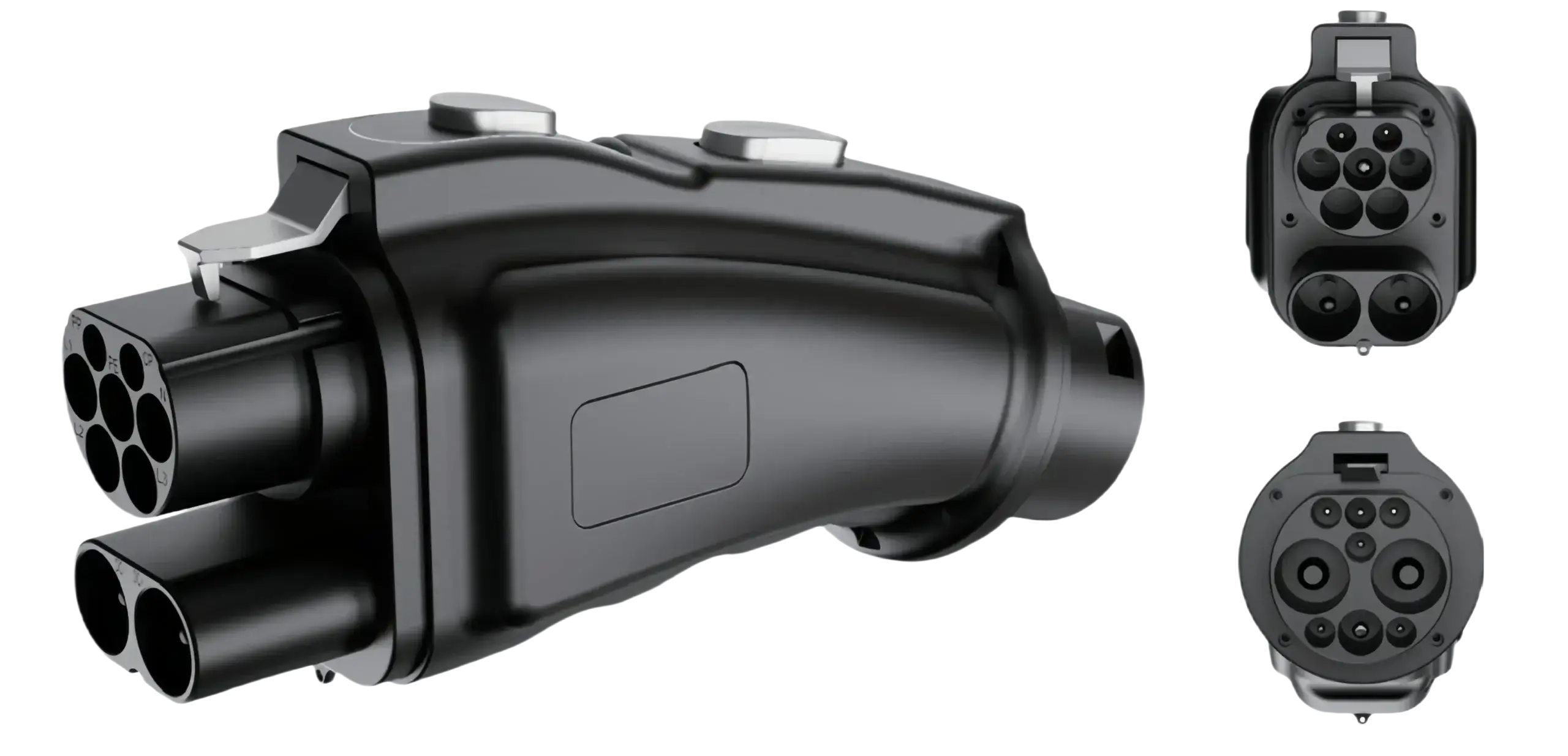
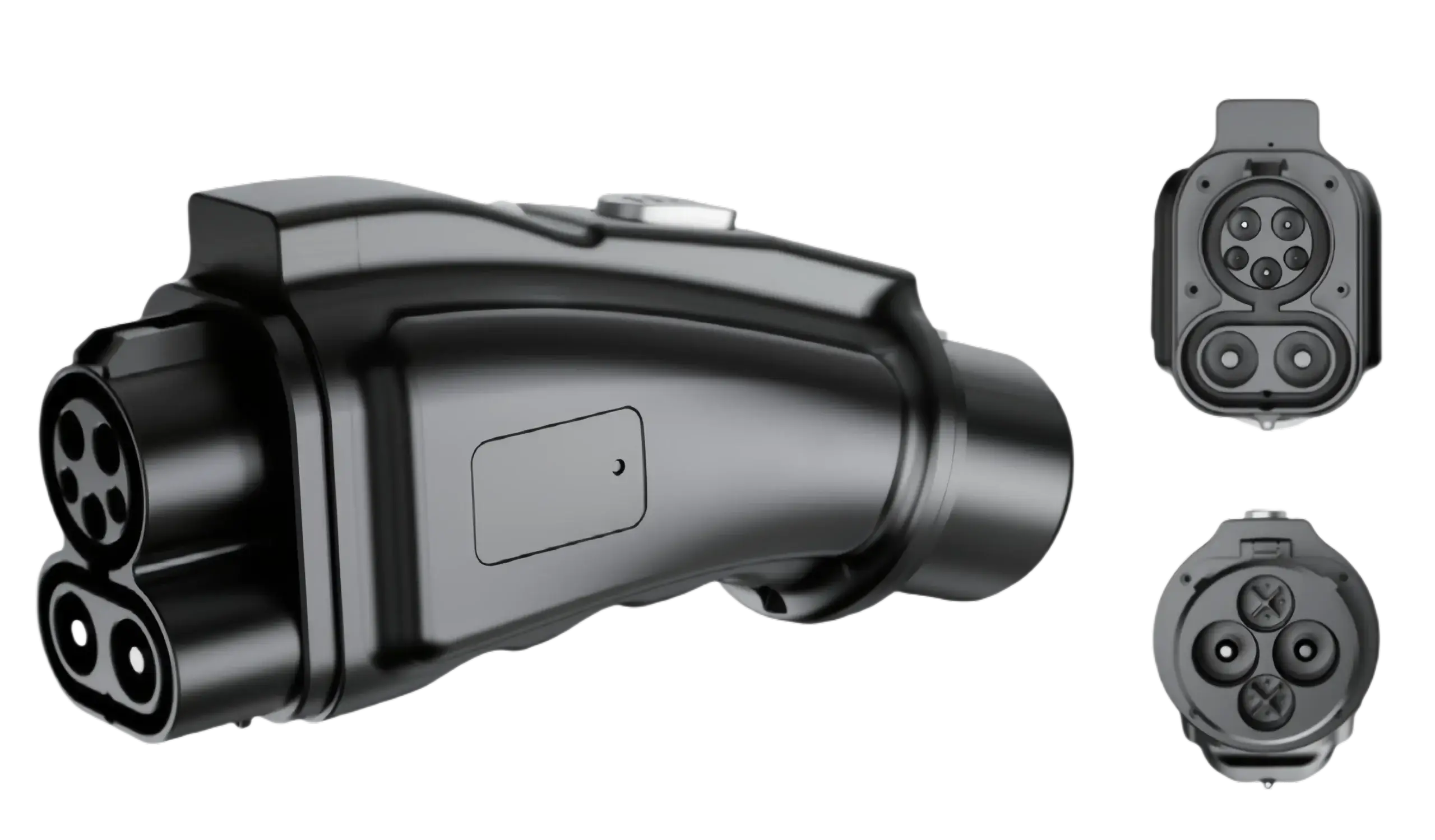
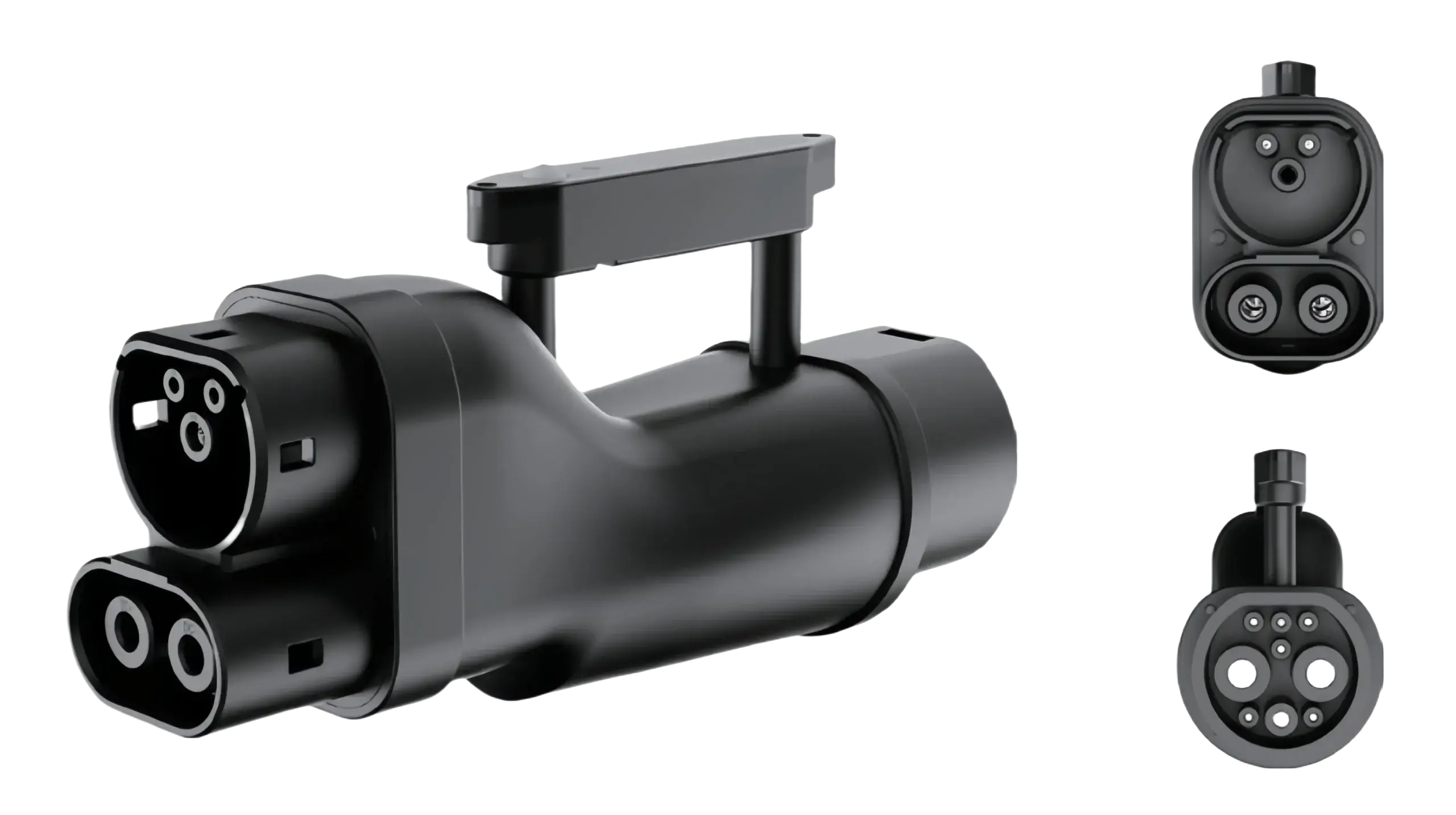
China builds more electric cars than any other country, and more of them reach European roads each year, through dealer networks and through private imports. The cars look similar, but the charging inlets are not, and that difference decides whether a driver can use a public fast charger at all. Comparing adaptateur de charge options by conversion direction is the quickest way to identify your inlet.
The answer depends on which version of the car you own, not on the country that built it. Chinese EVs sold new in Europe leave the factory with a CCS2 DC inlet and a Type 2 AC inlet, so they charge at European public chargers with no adapter involved. A China-spec or privately imported car keeps its GB/T 20234.3 DC inlet, which will not mate with a European DC connector. For those cars, a GB/T to CCS2 adapter decides whether a session happens at all, but only if it translates the charging protocol rather than the plug shape.
Why that matters becomes clear once you look at what happens in the seconds after a session starts.
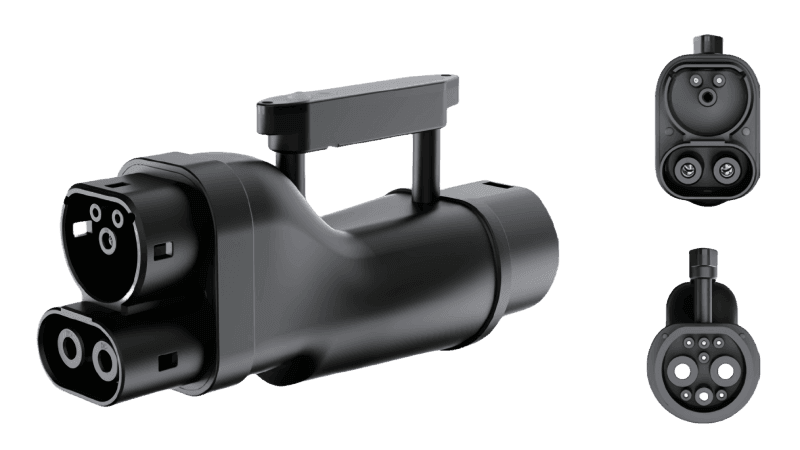
Most Chinese EVs sold in Europe already charge on CCS2
The cars that need an adapter are the exception. Manufacturers build separate export versions for Europe, and those versions carry CCS2 and Type 2 inlets because that is what the destination market is built around. If you bought the car from a European dealer, the question is already settled.
Vehicles placed on the European market go through whole-vehicle type approval, and their charging hardware is specified for the market they are sold in. The same model line sold in China keeps the domestic specification because the inlet is a different part rather than a software setting. The China-spec version often has two separate inlets, one for AC and one for DC, the structure GB/T was designed around, while CCS2 combines both in one inlet.
| Item to check | Vehicle built for Europe | China-spec or privately imported vehicle |
| DC fast charging inlet | CCS2, Combo 2, IEC 62196-3 | GB/T 20234.3, nine pins |
| AC charging inlet | Type 2, IEC 62196-2 | GB/T 20234.2, seven pins, separate inlet |
| European public DC fast charger | Plug in and charge | Needs a protocol-converting adapter |
| European public AC charger | Plug in and charge | Needs a separate AC adapter |
| Quickest way to identify it | One combined inlet | Two inlets, or one round nine-pin DC inlet |
Export-spec and China-spec vehicles are not the same car
The test takes ten seconds. A single combined inlet with two large pins under the Type 2 shell means the car speaks CCS2 and needs nothing. A round nine-pin connector means the car is on GB/T, and Europe’s DC network is closed to it without translation. No station in Europe will be rebuilt around the Chinese connector, so an adapter is the only add-on that opens the network.
What a GB/T to CCS2 adapter really changes
A working adapter changes two things at once, the metal and the language. The metal is straightforward engineering. The language is what separates an adapter that charges from one that sits in a drawer.
The connector is the easy part.
The GB/T 20234.3 DC connector is a nine-pin round design carrying the power path, two connection-confirmation circuits, a CAN pair, and a low-voltage auxiliary supply. CCS2, standardized in IEC 62196-3, keeps the Type 2 shell and adds two DC pins beneath it. Pin geometry, locking, and contact sizes differ, and an adapter has to mate with both ends while carrying the full rated current through its own contacts. That part gets solved.
The protocol is the part that fails.
On the GB/T side, the charger and battery management system communicate over a dedicated CAN network defined in GB/T 27930, built on CAN 2.0B at 250 kbit/s. On the CCS2 side, the same conversation travels as power line communication over the control pilot circuit, defined by ISO 15118 and its earlier companion DIN SPEC 70121. The station opens with a PLC handshake while the car listens for CAN frames, so the session times out before any current flows.
A passive adapter therefore fits perfectly and charges nothing. A working one carries a processor that presents itself to the car as a GB/T charger and to the station as a vehicle, translating voltage and current requests in both directions while watching for insulation faults and temperature spikes.
Which direction is your adapter named after?
Naming is not standardized, which causes ordering mistakes. The convention many suppliers follow names the ends from station to vehicle, so an adapter described as CCS2 to GB/T is the one an imported Chinese car needs, while products described as GB/T to CCS2 often mean the reverse conversion. Ask the seller which end goes into the vehicle. If the answer is vague, that is the answer.
When you need an adapter, and when you don’t
You need one only when the car’s DC inlet is GB/T and the station’s connector is CCS2. Every other combination, including an export-spec Chinese car at any European charger, needs nothing at all.
| Vehicle DC inlet | Station connector | Adapter required in Europe |
| CCS2, export-spec car | CCS2 | Non |
| GB/T, China-spec, or import | CCS2 | Yes, with protocol conversion |
| CCS2, export-spec car | GB/T | Yes, reverse direction, relevant in China |
| GB/T, China-spec, or import | GB/T | Non |
AC charging in Europe
European AC charging runs on Type 2 under IEC 62196-2. The Chinese AC connector, GB/T 20234.2, is also a seven-pin design and looks close enough to cause confusion, but the control signalling differs. A DC adapter does not solve this, because GB/T splits AC and DC into separate inlets, so a China-spec car needs a second, simpler adapter for Type 2 charging, one that carries alternating current and matches control signals.
DC fast charging in Europe
This is where the adapter earns its place. Public rapid charging in Europe is CCS2 by design, so a GB/T car without translation cannot use the fastest and most widely deployed part of the network. It is not a choice between fast and slower charging, but between charging and not charging.
Alternatives worth comparing
Three alternatives come up. Retrofitting a CCS2 inlet and the matching communication module changes the car’s high-voltage path and signalling, affects its approvals and warranty, and is a workshop job. A GB/T charger at your own depot suits a fleet with fixed routes and becomes useless on the road. Buying the export version is the cleanest answer, with the adapter in between, keeping an imported car usable without touching the vehicle.
How much power you actually get
Less than the figure on the charger and usually less than the figure on the adapter. Delivered power is the lowest of three limits: the adapter’s rating, the station’s output, and what the battery will accept at that moment.
Power equals voltage multiplied by current, so a 250 A limit produces very different results depending on the pack architecture.
| Vehicle pack architecture | Adapter current limit | Arithmetic ceiling |
| Around 400 V | 250 A | around 100 kW |
| Around 800 V | 250 A | around 200 kW |
The right-hand column is arithmetic from the rated current, not measured results, and a real session is also capped by the station and the car. Current, not voltage, is normally the binding constraint, which is why a high-voltage car gets roughly twice the power. Power falls away as the state of charge rises, which is normal on any DC session.
Choosing a GB/T to CCS2 adapter for European travel
Judge an adapter on continuous current, thermal behavior, firmware support, and compatibility with your specific model. Peak figures and unsupported claims tell you nothing about the tenth charging session.
Rated for continuous duty, not peak
A current rating is only useful with a duration and an ambient temperature attached. Ask for the continuous current at a stated ambient and the derating curve above it, because heat is the limiting factor at 250 A. Silver-plated copper alloy contacts keep resistance and heat generation down across repeated sessions.
Test evidence and certification
Any adapter sold into the European market has to meet the same electrical safety and electromagnetic compatibility rules as other mains-connected equipment, so CE marking and test documentation should be available on request.
Firmware and vehicle compatibility
Both sides of this bridge move. Charging standards get revised, and vehicle software updates change how a battery management system negotiates. An adapter with an update path survives that, while one without it becomes obsolete. Some battery management systems negotiate differently enough that adapters have needed separate firmware revisions, so ask for a model-level compatibility list.
Sealing, locking, and heat
IP54, while plugged in, is the common baseline for something that lives in a glovebox and has to work in the rain. The lock has to synchronize with the vehicle’s electronic lock so the connector cannot be pulled out under load. Published figures for one GB/T to CCS2 DC adapter show a workable specification.
| Paramètres | Published figure |
| Courant nominal | 250 A |
| Tension nominale | 1000 V DC |
| Indice de protection contre la pénétration | IP54 while plugged in |
| Température de fonctionnement | −30 °C to +50 °C |
| Housing material | Thermoplastique haute résistance |
| Contact material | Alliage de cuivre argenté |
| Poids net | 1.5 kg |
| Dimensions | 290 × 96 × 147 mm |
These are supplier-published figures for one product, a reference point rather than a recommendation, and worth re-checking against the current datasheet. A listing such as the GB/T to CCS2 DC adapter page shows which numbers are stated and which are missing.
Using an adapter on a public charging network
The sequence matters more than the driving. Test locally before a long trip, confirm the lock engages, start the session from the station, and never break the connection while current is flowing.
- Run one full session near home before relying on the adapter for a journey, so a compatibility problem costs you an afternoon rather than a holiday.
- Park so the adapter and cable are supported rather than hanging from the connector, since a cable pulling on the inlet is a mechanical risk.
- Plug the station connector into the adapter first, confirm it locks, then plug the adapter into the vehicle and confirm the second lock.
- Start the session from the station, using the network’s app, an RFID card, or a contactless terminal.
- Watch the vehicle’s dashboard rather than the station screen, since the car better indicates what the battery is accepting.
- End the session at the station, wait for the contactors to open, then disconnect the vehicle end first.
In practice most drivers using a protocol-converting adapter authenticate with a card, an app, or a contactless terminal rather than Plug and Charge, because the certificate exchange behind Plug and Charge happens between the car and the station. Carry more than one payment method.
Why Europe’s DC network is CCS2 in law
European law obliges the station side to speak CCS2, which is exactly why the adapter question exists for imported cars. It says nothing about which connector your car has to use.
Le Alternative Fuels Infrastructure Regulation (EU) 2023/1804 has applied since 13 April 2024 and sets binding technical specifications for recharging infrastructure across the member states. Its annex was amended by a delegated regulation in 2025, which requires publicly accessible DC recharging points for light-duty electric vehicles installed or renovated from 8 January 2026 to be equipped, for interoperability, at least with Combo 2 vehicle connectors for Mode 4 recharging as described in EN IEC 62196-3:2022. Europe’s public DC connector is CCS2, and it will stay CCS2.
For the driver of an imported car that cuts both ways. The network is predictable, so one adapter can cover a continent. The vehicle side is your own responsibility, because the regulation governs charging points rather than cars, and warranty terms were not written with a third-party adapter in mind.
Foire aux questions
Can I use a GB/T to CCS2 adapter for AC charging as well?
No. These adapters handle DC fast charging only and are built around the DC pins and the communication bridge. GB/T vehicles use a separate AC inlet under GB/T 20234.2, so a European Type 2 AC point needs a different and far simpler adapter.
Does using an adapter affect my vehicle warranty?
There is no general rule, and it depends on the wording of your warranty. A defect that a manufacturer can trace to an aftermarket device is normally excluded, while a correctly rated and certified adapter is less likely to become an issue. Raise the question with your dealer before relying on it daily.
Can I leave the adapter connected at a public charger while I am away?
Physically, yes, and some adapters lock to the vehicle so they cannot be removed by hand. The risks are practical rather than electrical, meaning theft and vandalism at unattended sites. On a long motorway stop, stay near the car.