
Choosing the right equipment for maintaining charging infrastructure has become quite a mission lately. With the sheer variety of stations popping up—from home garages to massive highway hubs—the need for a solid EV Charger Testing Device is no longer just for the “hardcore” electrical engineers. It’s about ensuring safety, verifying that the communication protocols are shaking hands correctly, and making sure nobody gets a nasty surprise when they plug in.
For anyone tasked with commissioning or maintaining these units, the market offers some interesting choices. We aren’t just looking at simple multimeters anymore; we’re looking at specialized kits that simulate a car’s behavior so you don’t have to risk a real vehicle just to see if a port is live. It’s a bit of a jungle out there, frankly.
Why You Can’t Just Use a Multimeter
It is easy to think, “Hey, it’s just electricity, right?” and assume a standard voltage tester might do the trick. But EVSE (Electric Vehicle Supply Equipment) is a bit more temperamental. The station won’t even send power unless it “feels” a vehicle on the other end.
This is where a dedicated EV Charger Testing Device comes into play. It mimics the Proximity Pilot (PP) and Control Pilot (CP) signals. Essentially, it tricks the charging station into thinking a car is plugged in and asking for juice. Without that handshake simulation, you are basically staring at a plastic box that refuses to do anything.
Observing the industry lately, it seems safety has become the biggest driver for buying these specific tools. A generic meter won’t tell you if the RCD (Residual Current Device) trips fast enough, and that is the kind of failure that keeps facility managers awake at night.
Key Features to Look For
Before diving into the specific recommendations, there are a few things that seem to separate the toys from the professional gear.
- Simulation Capabilities: Can it simulate different cable ratings? Can it simulate a car that requires ventilation?
- Portability: Some of these “portable” units are actually quite heavy. If the job involves walking across a massive parking lot, weight matters.
- Safety Ratings: CAT III or CAT IV ratings are non-negotiable when dealing with mains electricity.
Top 3 Recommended Tools
Based on general utility and what seems to be working for technicians in the field, here are three distinct types of EV Charger Testing Device options that cover most bases.
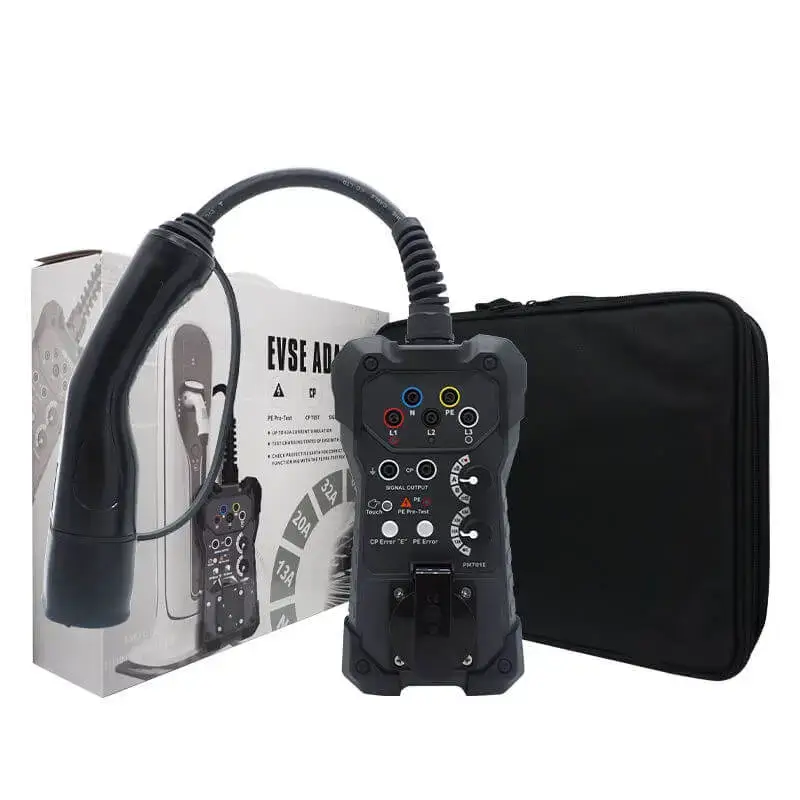
1. The Professional Portable EVSE Tester
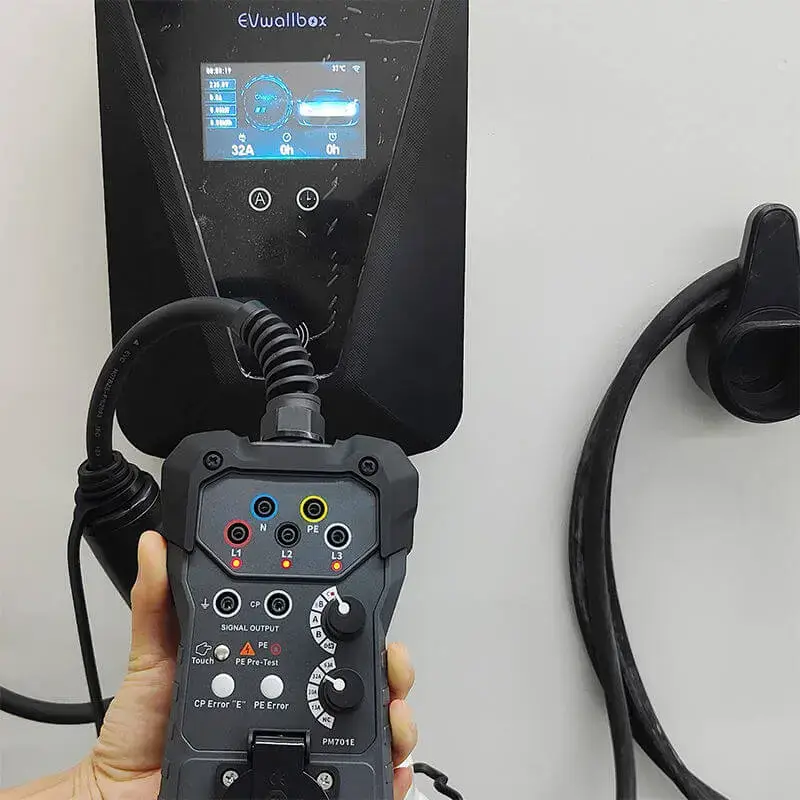
First up is the handheld variety. This type of EV Charger Testing Device is usually compact—something you can throw in a backpack or a small tool bag without thinking twice.
What’s nice about the professional portable models is that they usually strip away the complexity. You plug it in, turn a dial to simulate “Vehicle Connected,” turn another dial to simulate “Charge Requested,” and watch the lights. It’s intuitive. There is no need to navigate complex touchscreens when it’s raining and you just want to know if the station works.
2. The EV Charger Tester Box
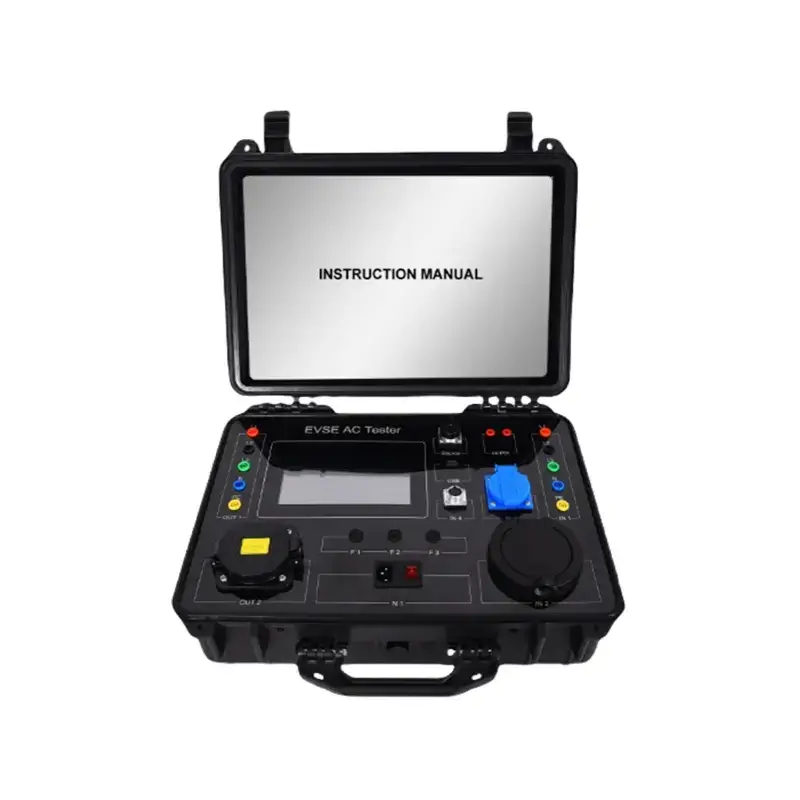
Moving up a notch, we have the “Tester Box” style. These are usually a bit bulkier, often resembling a small briefcase or a ruggedized plastic container.
The EV Charger Tester Box is typically designed for the technician who needs to do a comprehensive commissioning. It’s not just about “does it work?”; it’s about “is it working perfectly?”
One observation about these boxes is that they often include dedicated BNC terminals. This allows you to hook up an oscilloscope to actually see the PWM (Pulse Width Modulation) square wave of the Control Pilot signal. That might sound like overkill to a beginner, but when a specific car model refuses to charge at a specific station, seeing that waveform is the only way to diagnose the problem. It feels more substantial, more like a serious diagnostic lab brought into the field.
3. The Universal EVSE Adapter for Multifunction Testers
This is a clever category. Instead of being a standalone tester, this is an EV Charger Testing Device that acts as an interface. It plugs into the charging station on one side, and on the other side, it has standard inputs for your existing Multifunction Installation Tester (MFT). If a workshop already owns high-end Fluke or Megger installation testers, this is often the smartest buy. It saves money because you aren’t buying a second screen or processor; you are just buying the simulator part.Quick Comparison of Device Types
To make it a bit clearer, here is a breakdown of how these different tools stack up against each other.Practical Considerations for Field Use
When actually out there using an EV Charger Testing Device, things happen that specs don’t tell you. For instance, cable length. Some tester boxes come with a painfully short plug cable, meaning you have to hold the box in the air while testing wall-mounted chargers. It sounds like a minor annoyance, but try doing that for twenty stations in a row—your shoulders will hate you. Another thing to watch out for is the quality of the selector switches. Since the core function of these devices is to switch between State A (Disconnected), State B (Connected), and State C (Charging), those switches get hammered. Flimsy plastic dials tend to feel loose after a few months of heavy use.| Feature | Portable Handheld Tester | EV Charger Tester Box | Universal Adapter |
|---|---|---|---|
| Primary Use | Quick inspection, routine maintenance, basic functionality checks | Comprehensive diagnostics and fault troubleshooting | Installation verification and certification testing |
| Portability | High (compact, pocket-sized or small pouch) | Medium (portable case with handle) | High (compact, but requires a separate testing instrument) |
| Waveform Access | Rarely available | Yes (BNC ports for oscilloscope connection) | Depends on the connected multifunction tester (MFT) |
| Cost Level | Low to mid-range investment | Mid to high investment | Low (hardware interface only) |
A Note on Safety Protocols
It feels necessary to mention that owning the device doesn’t make the user safe automatically. These devices often allow you to expose live conductors for testing.- Always check the PE Pre-Test: Most good testers have a touch-pad to check for hazardous voltages on the earth line. Do not skip this.
- CP Error Simulation: A good EV Charger Testing Device should have a button to simulate a “CP Error.” You need to press this to make sure the station cuts the power immediately. If it doesn’t, that station is a hazard.


 English
  Spanish
  Portuguese
  French
  Russian
  German
  Italian