
In the high-stakes world of electric vehicle infrastructure, the EV Charging Compliance Tester is the ultimate arbiter of safety and functionality. These devices are tasked with a heavy burden: simulating the complex behavior of an electric vehicle to ensure that high-voltage charging stations adhere to rigid international standards like IEC 61851-1.
However, even the most robust EV Charging Compliance Tester is not immune to faults. When a test fails in the field, the technician faces a critical question: Is the charging station broken, or is the tester itself providing a false reading? Understanding the common failure points of these diagnostic tools is essential for maintaining uptime and ensuring that compliance isn’t just a checkbox, but a reality.
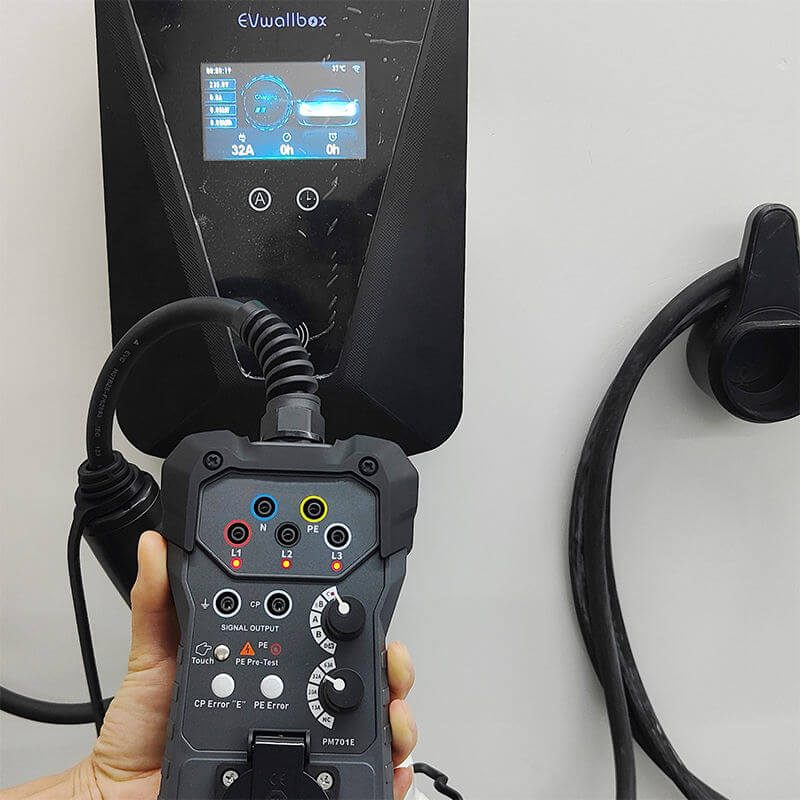
Communication Impediments within the EV Charging Compliance Tester
The most frequent issues encountered during site audits are communication failures. If the EV Charging Compliance Tester cannot establish a “handshake” with the charging station, the entire testing process grinds to a halt.
Control Pilot (CP) Signal Distortion
The CP signal is a 1kHz square wave that communicates the state of the vehicle to the charger via Pulse Width Modulation (PWM). A common fault in a worn EV Charging Compliance Tester is the degradation of the internal resistor bridge used to toggle between State A (Disconnected), State B (Connected), and State C (Charging).
If the internal switching relay or semiconductor in the tester becomes “sticky” or develops high resistance, the voltage levels—which should be exactly 12V, 9V, or 6V—may drift. For instance, if State B registers at 9.5V instead of 9V, the charging station may fail to recognize the “vehicle” and refuse to initiate the charge.
Proximity Pilot (PP) Resistor Errors
The PP circuit tells the charger the maximum current capacity of the cable. Faulty EV Charging Compliance Tester units often suffer from worn-out PP resistors. If the tester’s internal resistance value doesn’t match the expected Ohm rating (e.g., 220Ω or 680Ω), the station may enter an error state or limit the current to a trickle, leading to inaccurate performance data.
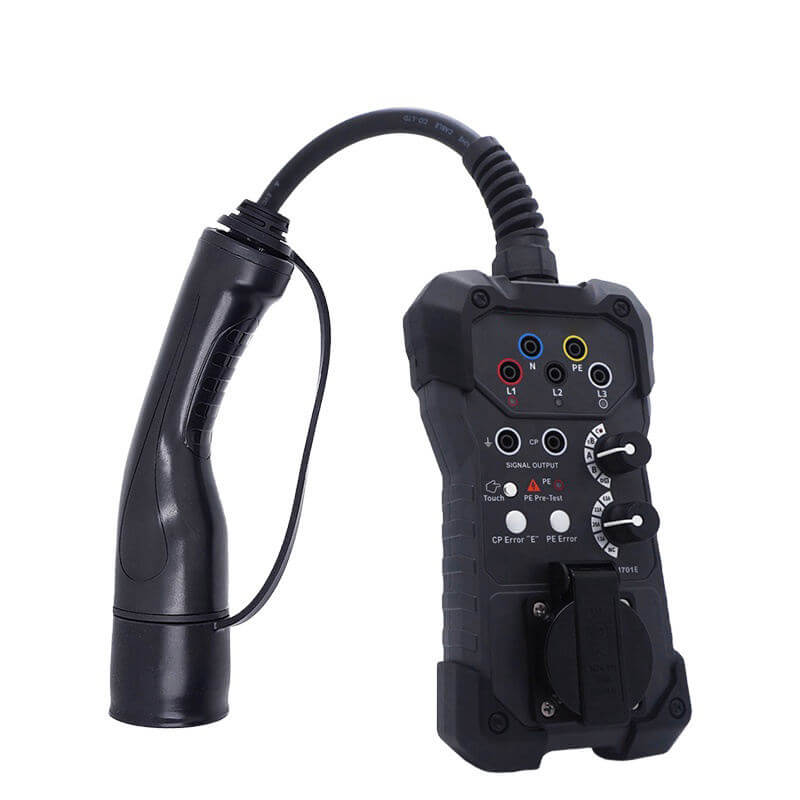
Resolving False Positives in EV Charging Compliance Tester Grounding Tests
Safety is the primary driver of compliance, and the grounding (PE) test is the most critical safety check. However, the EV Charging Station Tester can sometimes produce “ghost faults” regarding ground integrity.
The “Ground Missing” Paradox
Many technicians have encountered a situation where the EV Charging Compliance Tester reports a missing ground, yet a manual check shows the station is perfectly earthed. This is often caused by high contact resistance within the tester’s own input socket. Over time, dust and oxidation create a thin insulating layer on the tester’s internal PE pin.
When the device attempts to run a Loop Impedance test, this micro-layer of grime adds several Ohms to the reading, triggering a “Ground Fault” warning. In this scenario, the tester is technically “at fault” by being too sensitive or poorly maintained, rather than the station being unsafe.
RCD/GFCI Nuisance Tripping
A high-quality EV Charging Compliance Tester must be able to test the Residual Current Device (RCD) without blowing the main breaker. A common fault occurs when the tester’s internal leakage simulation circuit fails. If the tester dumps too much current too quickly during a ramp test, it can cause a total site blackout rather than a controlled trip of the individual charger. This usually points to a failure in the tester’s timing logic or calibrated leak resistors.
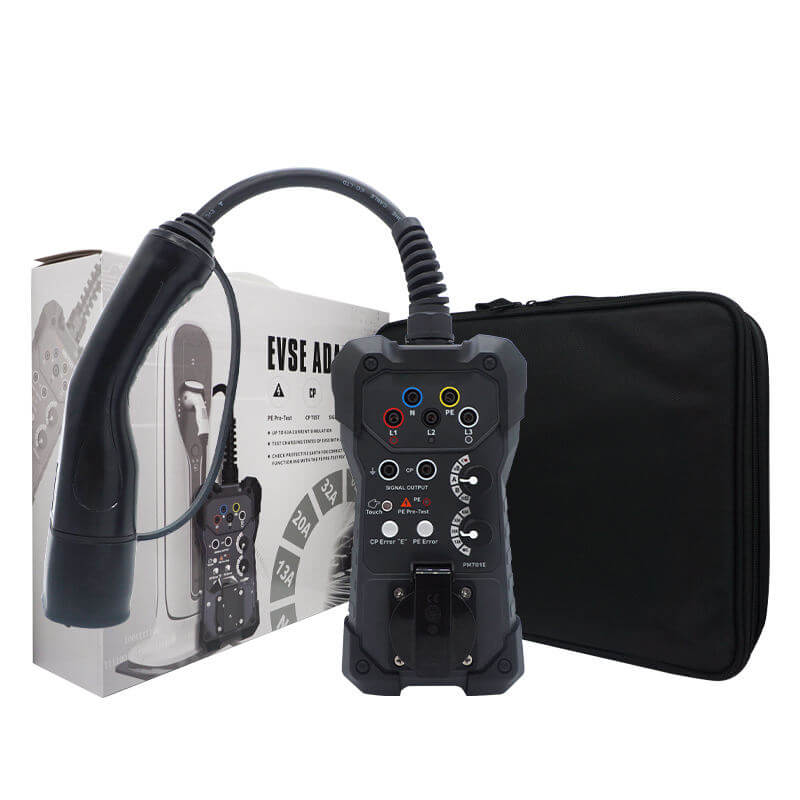
Physical Degradation of EV Charging Compliance Tester Cables and Connectors
Because these tools are used in the mud, rain, and gravel of construction sites, mechanical failure is an inevitability that affects the EV Charging Compliance Tester’s accuracy.
Connector Pin Fatigue
The Type 2 or Type 1 plug on your EV Charging Compliance Tester is a mechanical component with a finite lifespan. Each time it is inserted into a socket, the spring-loaded sleeves inside the connector lose a fraction of their tension. Eventually, this leads to “signal jitter.” You might see the CP signal on your tester’s screen jumping erratically. This isn’t a fault with the charger’s software; it is a physical loose connection inside the tester’s handle.
Cable Shielding Breach
The cables connecting the main unit of the EV Charging Compliance Tester to the vehicle inlet carry sensitive data signals alongside potential high-voltage measurements. If the internal shielding is compromised due to being stepped on or pinched in a van door, the tester may pick up electromagnetic interference (EMI) from the charging station’s own power electronics. This leads to “Noisy Signal” errors, which are notoriously difficult to diagnose if you aren’t looking for physical cable damage.
Software Glitches and Firmware Lag in the EV Charging Compliance Tester
As EV protocols evolve (with the introduction of ISO 15118 and bidirectional V2G charging), the software inside the EV Charging Compliance Tester must keep pace.
Protocol Mismatch
A common “fault” that is actually a compatibility issue occurs when an older EV Charging Compliance Tester attempts to audit a modern “Smart” charger. If the charger expects a digital high-level communication (HLC) handshake and the tester only provides basic analog PWM, the tester may hang or report a “Timeout Error.”
Data Corruption during Logging
Many testers save logs to an internal SD card or sync via Bluetooth to a mobile app. A frequent fault in the EV Charging Compliance Tester ecosystem is the corruption of these logs during long-duration load tests. If the tester’s processor overheats while monitoring a 22kW charge for an hour, it may stop writing data to the memory, resulting in a “Null Report.” This is often a sign that the tester’s internal thermal management or buffer memory is insufficient for high-load commercial testing.
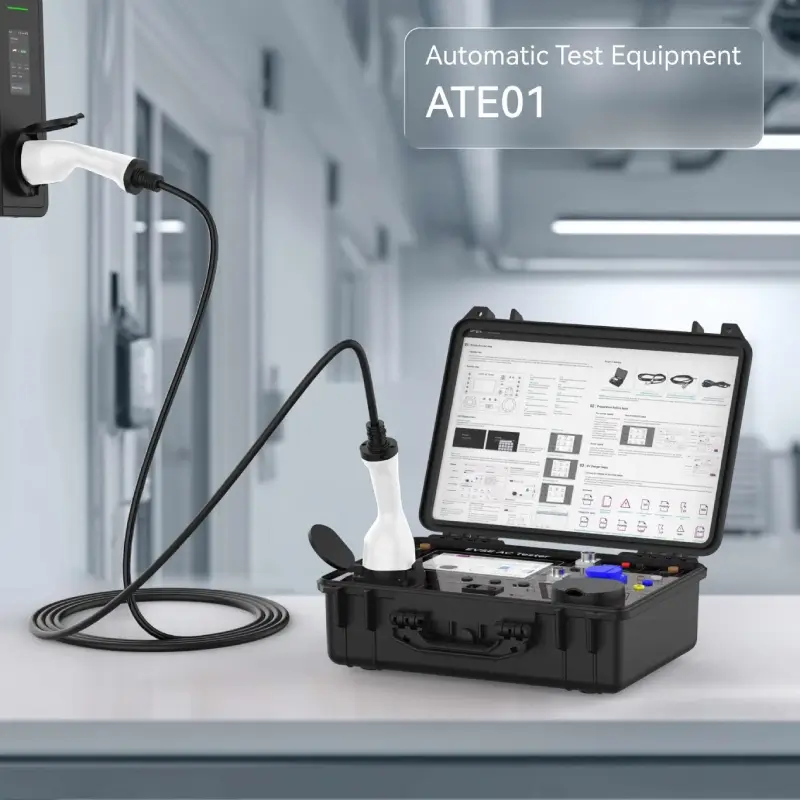
Interpreting Error Codes on the EV Charging Compliance Tester
When an EV Charging Compliance Tester displays an error code, it isn’t just a random alert; it is the result of a failed logical sequence in the communication between the EVSE and the tester’s internal processor. To the untrained eye, these codes are frustrating roadblocks. To a master technician, they are a diagnostic roadmap.
A. Control Pilot (CP) Out-of-Range Faults
This is perhaps the most frequent error displayed on an EV Charging Compliance Tester. In a healthy system, the CP signal operates on a ±12V range.
The Symptom: The tester shows “CP Signal Error” or “Invalid Duty Cycle.”
The Technical Reality: This often happens when the tester’s internal loading resistors—which simulate States B (9V) or C (6V)—have drifted due to thermal stress. If the tester’s internal resistance is slightly off, the resulting voltage may land in a “dead zone” (e.g., 7.5V), which doesn’t correspond to any standard state. The EV Charging Compliance Tester then throws an error because it cannot interpret the handshake.
Troubleshooting: Check if the tester’s CP diode simulation is still functional. A “leaky” diode in the tester can cause the negative part of the PWM signal to collapse, leading to a permanent “State E” (Error) report from the charger.
B. Proximity Pilot (PP) Open Circuit or Resistance Mismatch
The PP signal is static and relies on specific resistor values to tell the charger what the cable can handle.
The Symptom: “PP Fault” or “Cable Amperage Unknown.”
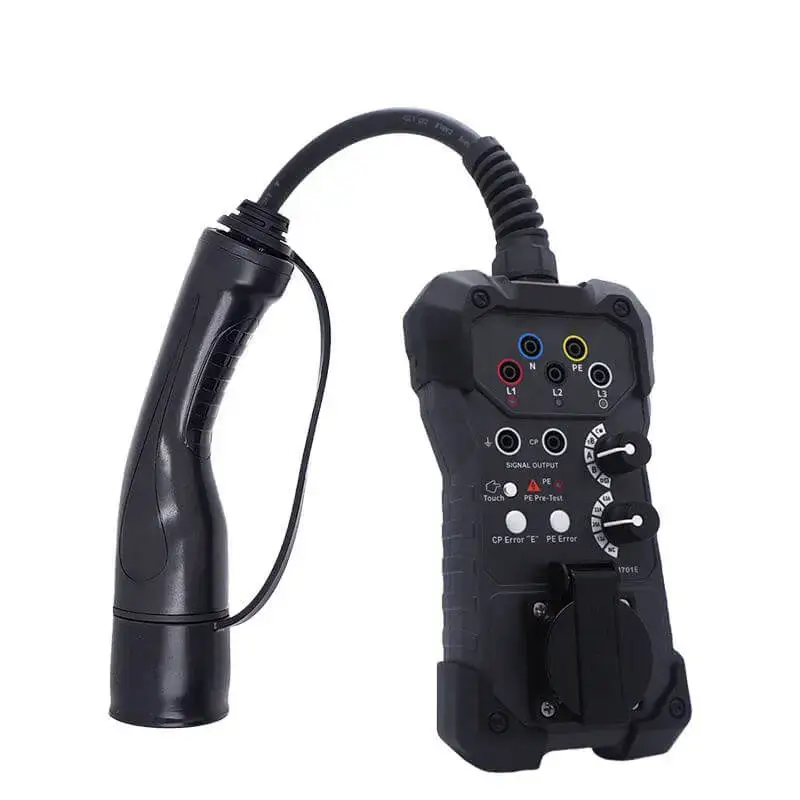
The Technical Reality: In many EV Charging Compliance Tester units, the internal PP selector switch (used to toggle between 13A, 32A, 63A) can develop high contact resistance due to oxidation. If you select 32A (220Ω), but the internal switch adds 50Ω of resistance, the total 270Ω doesn’t match the IEC 61851-1 lookup table.
Field Fix: Cycle the selector switch 10–20 times to “self-clean” the internal contacts, or use a high-quality contact cleaner spray.
C. Protective Earth (PE) Pre-Test Failures
Before any power is allowed to flow, a high-end EV Charging Compliance Tester performs a “PE Pre-Test.”
The Symptom: “Touch Voltage High” or “PE Potential Error.”
The Technical Reality: This is a critical safety fault. It means the tester has detected a voltage potential on the grounding wire itself. This could be a fault in the charging station (e.g., a neutral-to-earth leak), but it can also be a fault in the EV Charging Compliance Tester’s internal reference electrode. If the technician is wearing highly insulated boots and touches the tester’s “Touch Pad” (a common feature on compliance testers), the lack of a path to ground can sometimes trigger a “false positive” PE error.
D. Detailed Diagnostic Code Reference Table
To help your team differentiate between tester issues and charger issues, refer to this standardized logic table used by most EV Charging Compliance Tester manufacturers:
E. The “Logic Hang” in Compliance Testing
Occasionally, an EV Charging Compliance Tester may simply “lock up” when switching from State C (Charging) back to State B (Standby). This is often a software-level fault within the tester’s firmware where it fails to clear the buffer of the previous test. If this occurs, it’s vital to perform a “Full Discharge” of the tester (unplug all cables and power cycle) to ensure the internal capacitors aren’t holding a residual charge that interferes with the next measurement.
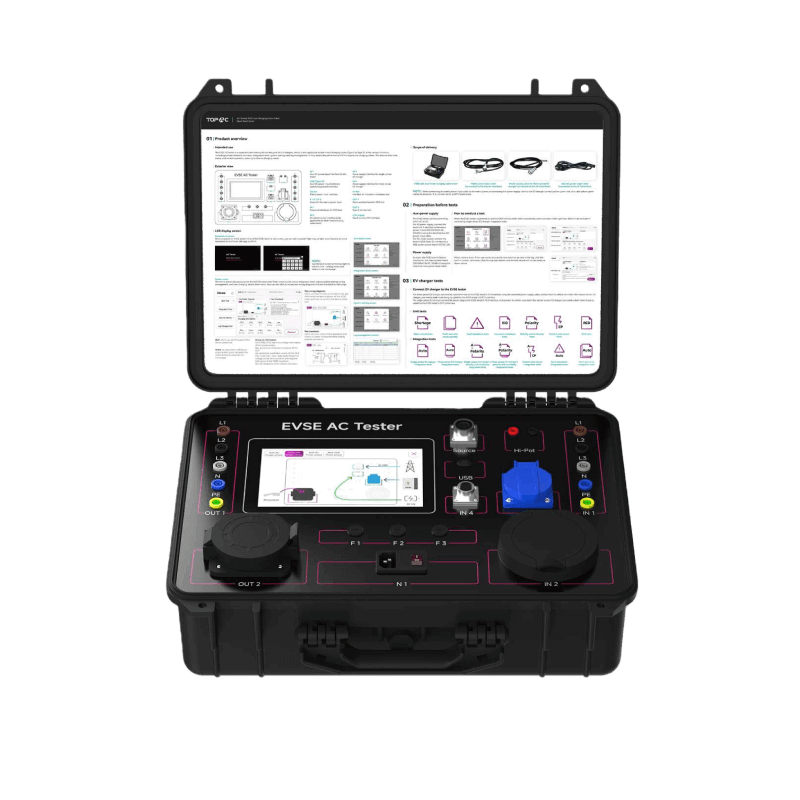
Proactive Strategies to Prevent EV Charging Compliance Tester Failures
To minimize these common faults, a proactive maintenance mindset is required. You shouldn’t wait for a failure in the field to address the health of your EV Charging Compliance Tester.
The “Null” Test: Before heading to a site, plug your tester into a known-working “reference” charger at your office. This confirms that the internal relays and the CP/PP logic are functioning before you commit to a long drive to a customer site.
Contact Preservation: Use a high-quality, non-residue contact cleaner on the tester’s pins every month. Avoid using generic lubricants which can actually attract dust and lead to the very grounding faults you are trying to prevent.
Firmware Audits: Set a calendar reminder to check the manufacturer’s website for firmware updates every quarter. This ensures your EV Charging Compliance Tester remains compatible with the latest vehicle-to-grid communication protocols.
Conclusion: Reliability Starts with the Tester
An EV Charging Compliance Tester is the shield between a safe infrastructure and a dangerous one. However, as we have explored, the tester itself can become the source of confusion if not properly understood and maintained. From CP signal distortion to physical pin fatigue and software lag, the “faults” you encounter in the field are often a combination of environmental stress and tool wear.
By mastering the troubleshooting steps for your EV Charging Compliance Tester, you ensure that your diagnostics are beyond reproach. In the EVSE industry, accuracy is the only thing that builds long-term trust. When your tester says a station is safe, you need to be 100% sure that the tester itself is telling the truth.
More information:
FAQ
Q: Why does my tester show a "Phase Loss" when all phases are clearly present?
A: This is a common fault in the internal sensing fuses of an EV Charging Compliance Tester. If one of the internal protection fuses has blown due to a previous voltage spike, the tester will “see” a missing phase even if the station is outputting correctly.
Q: Can a low battery in my EV Charging Compliance Tester cause incorrect CP readings?
A: Yes. Many testers use the internal battery to power the reference voltage for the CP simulation. If the battery is nearly dead, the 12V reference may drop to 11V, causing the charging station to misinterpret the state of the “vehicle” and trigger a communication error.
Q: My EVSE tester's screen is flickering during high-current tests. Is this a fault?
A: Most likely. This indicates that the internal shielding or voltage regulation of the EV Charging Compliance Tester is failing to handle the electromagnetic field generated by the high-current flow. It is recommended to have the unit serviced to check for loose internal shielding or failing capacitors.


 English
  Spanish
  Portuguese
  French
  Russian
  German
  Italian