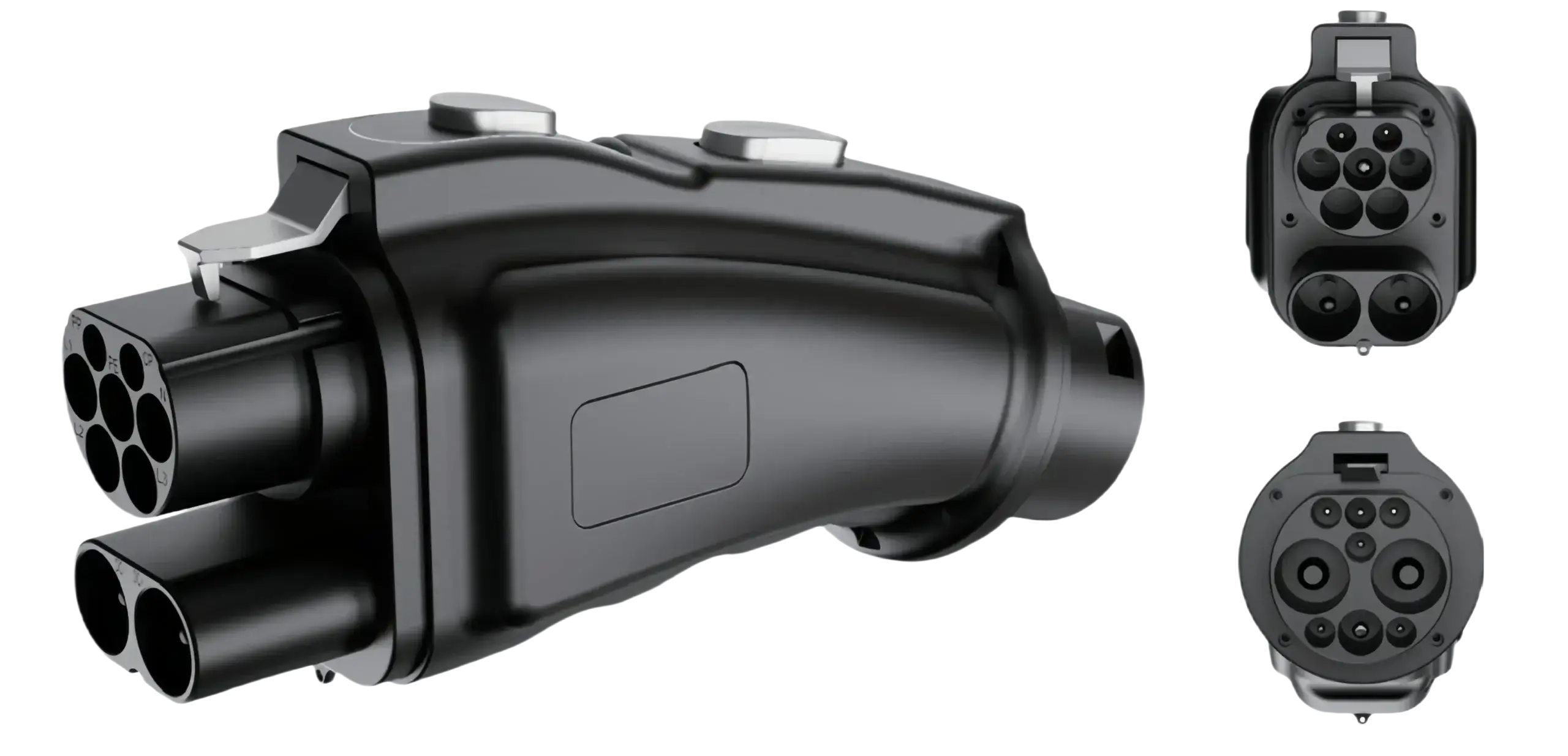
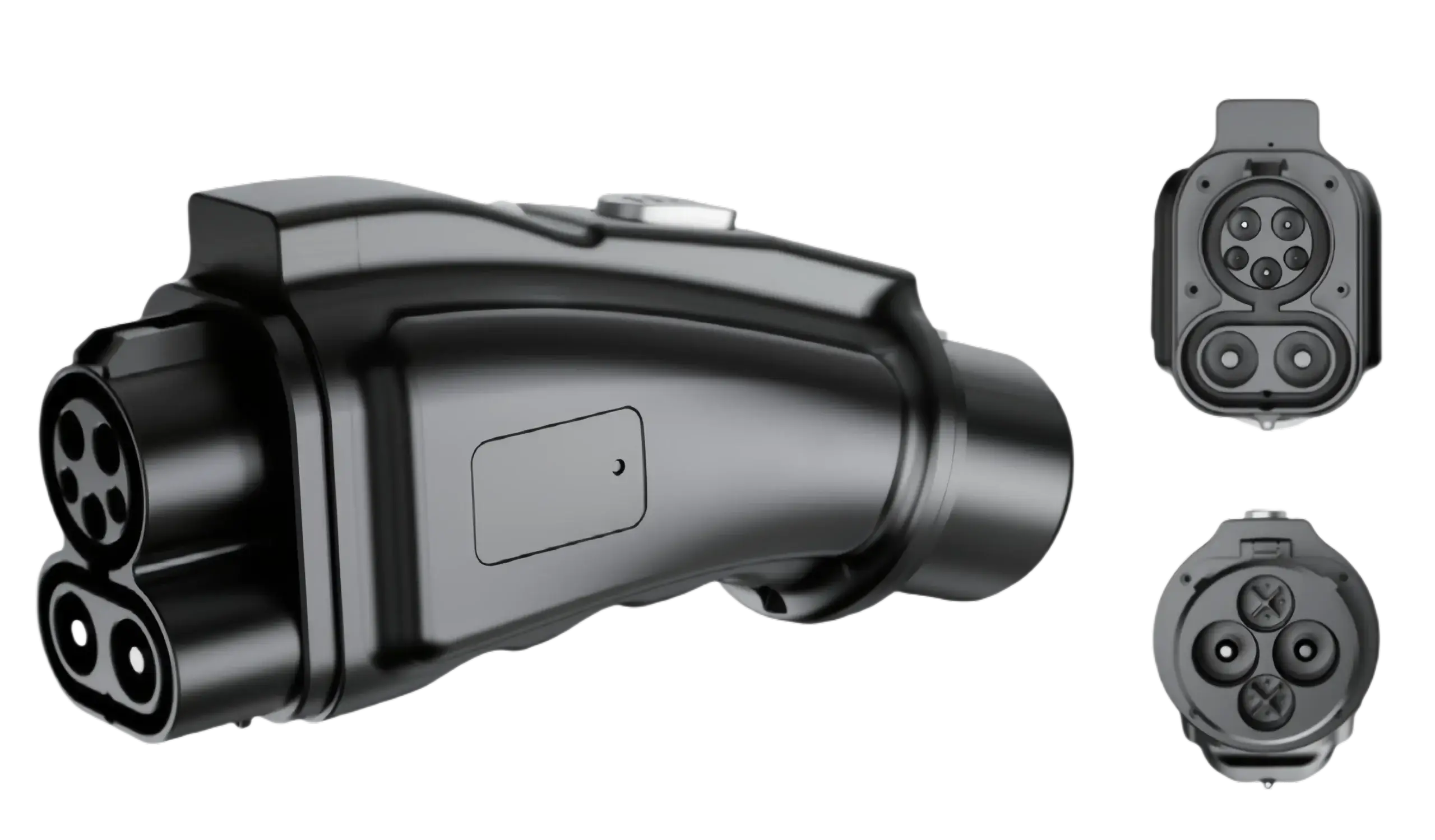
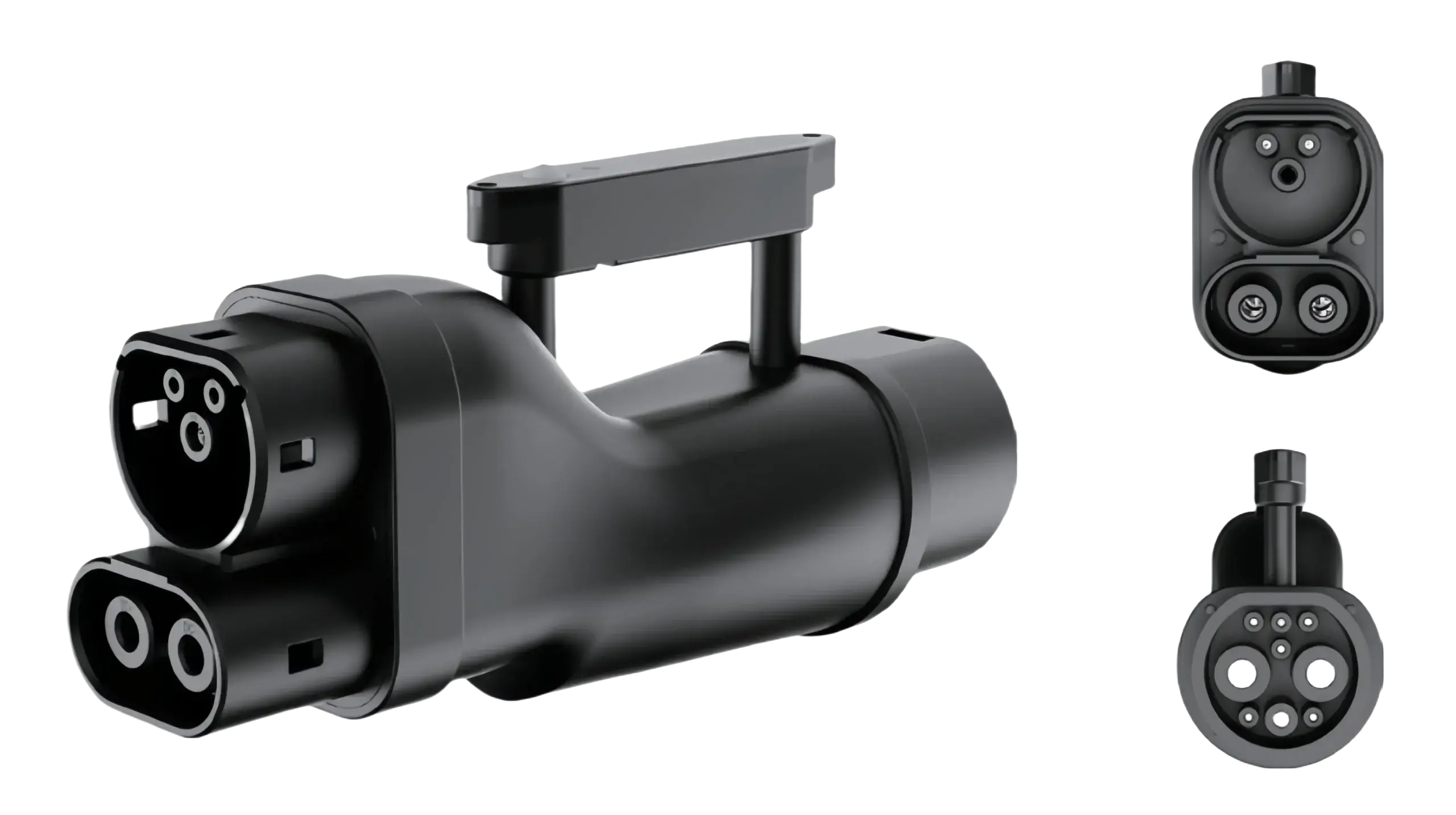
DC fast charging across North and South America has consolidated around two connectors, CCS1 and NACS, while CHAdeMO—the standard that carried most early Japanese electric vehicles—has stopped expanding. Those cars are still in daily use and still moving through the used market, but the stalls they were designed around are being replaced rather than renewed. For owners and for the fleets still running them, the problem is not the vehicle. It is access. A CCS1 to CHAdeMO DC adapter is the least expensive part in the chain that restores it.
A CCS1 to CHAdeMO DC adapter is an active device that allows a vehicle with a CHAdeMO DC inlet to charge at a CCS1 DC fast charging station. It does more than bridge two plug shapes: it translates the station’s communication protocol into the signals the vehicle expects and manages current delivery for the length of the session, so the charge behaves like any other rapid charge, capped by the vehicle’s battery management system and by the station’s output.
The sections below cover how the adapter works, which vehicles and stations it fits, how to read the specification sheet, and what to verify before ordering in volume.
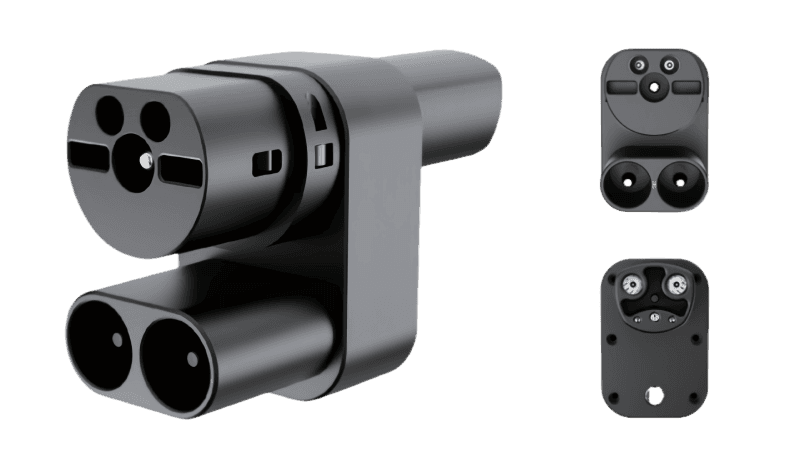
What a CCS1 to CHAdeMO adapter does
It turns a CCS1 DC charging cable into a working CHAdeMO charging source. The CCS1 side couples to the station’s CCS1 DC connector, the CHAdeMO side couples to the vehicle inlet, and the electronics in between perform the handshake that the two standards do not share.
The two standards were designed independently and speak different languages. A CCS1 DC station runs the session over power line communication, following ISO 15118 and its earlier DIN 70121 profile. A CHAdeMO vehicle expects CAN bus signalling and its own sequence of checks. No passive connector can reconcile that, which is why these parts carry a controller board and why published data sheets describe them as active adapters. Designs differ in how the controller is powered: some draw from the station, others use an internal rechargeable cell that has to be topped up between uses. That detail is worth confirming before purchase, because a flat controller means no session.
Two limits follow from the design itself. First, the adapter serves DC fast charging only. CHAdeMO vehicles carry a separate inlet for AC charging, so this part changes nothing about how the car charges overnight or at a slower public post. Second, conversion runs in one direction: a CHAdeMO vehicle at a CCS1 station. It does not give a CCS1 vehicle access to CHAdeMO stalls, and it has no effect on any connector other than these two.
CCS1, CHAdeMO, and NACS at a glance
| Connecteur | Where it is the norm | Type de recharge | Reachable by a CHAdeMO vehicle |
|---|---|---|---|
| CCS1 (SAE J1772 combo) | North and South America | AC and DC fast | Yes, with a CCS1 to CHAdeMO adapter |
| CHAdeMO | Japan, and early EVs exported worldwide | DC fast only | Native |
| NACS (SAE J3400) | North America, expanding | AC and DC fast | Not through this adapter |
The U.S. Department of Energy’s Alternative Fuels Data Center groups DC fast charging into three DC fast charging systems—CCS, CHAdeMO, and J3400—and notes that a single charging port can carry more than one connector type. That one fact explains the shape of the market. Multi-standard dispensers serve everyone. Single-standard stalls serve only the drivers whose vehicles match, which is why a CCS1-only site is a dead end for a CHAdeMO car.
For a CHAdeMO vehicle, the last column is the one that matters. CCS1 is reachable with the adapter. NACS is not, at least not through this part, so route planning still has to separate the two.
Why CHAdeMO drivers need one now
Because new DC fast charging is being built for CCS1 and NACS, and existing CHAdeMO cables are being decommissioned rather than replaced. The vehicles stay usable; their access to fast charging is what narrows. An adapter restores that access for far less than the cost of changing vehicles.
The shift comes down to where the money goes. Operators adding stalls in North America now buy hardware that matches the connectors on new vehicles, which means CCS1 and NACS. CHAdeMO hardware still exists at many sites, often as a single cable on a multi-standard dispenser, but new installations rarely add it, and older units sometimes disappear when a site is refurbished. A driver feels this as uneven coverage rather than a hard cutoff. A corridor that once offered three compatible stalls may now offer one, and the one that remains may be a lower-power unit shared with other drivers.
For buyers, that has two consequences. A vehicle that cannot use a modern fast-charging network is worth less on the resale market, so an adapter protects residual value. And for anyone whose driving depends on fast charging rather than overnight charging at home, reliability of coverage matters more than peak speed. An adapter adds no stalls, but it widens the pool a given vehicle can use, which is usually the difference between a planned stop and no stop.
What it changes for fleets and site operators
Three cases come up most often.
- Mixed fleets. A logistics service or municipal fleet still running CHAdeMO vehicles alongside newer CCS1 vehicles does not have to maintain two charger categories. One adapter per older vehicle ends the split.
- Rental, hospitality, and car-share operations. Customers arrive with whatever they own. Keeping compatible adapters on hand stops a charging failure at the property from turning into a customer service problem.
- Site operators. A CCS1-only installation excludes every CHAdeMO driver in the area. For a site that wants those drivers as users, an adapter is a low-cost way to widen the addressable base without rebuilding a dispenser.
How a charging session works
The session is a three-step sequence. Couple the adapter to the station, couple it to the vehicle, then authorize the charge through the station as usual. Everything else—the protocol handshake, the safety checks, and the current negotiation—happens inside the adapter.
- Couple the adapter to the station’s CCS1 DC connector and push until it seats fully.
- Couple the CHAdeMO side to the vehicle’s DC inlet and confirm the latch engages.
- Authorise the session using the station’s normal method, then watch progress on the vehicle display or the station screen.
Past that point the adapter’s work is continuous. It runs the insulation and continuity checks the station expects, presents the vehicle’s charging parameters to the station, reports faults, and monitors temperature at the contacts. When something drifts outside range, a well-built unit signals the station to reduce current instead of letting the fault escalate. Silver-plated copper alloy contacts help here, because lower contact resistance produces less heat at high current, and heat is the constraint that governs why this hardware is built for hundreds of amps rather than tens.
What the adapter handles and what it cannot
The adapter is responsible for protocol translation between the station’s power line communication and the vehicle’s CAN bus signalling, for fault and insulation detection, for thermal monitoring with current throttling, and for mechanical and electrical locking so the connection cannot be broken while current is flowing.
It is not responsible for everything else. It cannot raise the power your vehicle will accept, because the battery management system sets that ceiling. It cannot be used for AC charging, since it has no path for it. It cannot be used at a stall that offers only a CCS2 or NACS connector. And it is a third-party accessory: adapters of this type are not generally certified or endorsed by vehicle manufacturers or the CHAdeMO association, so where a charging fault is traced back to the adapter, a manufacturer’s warranty position on that specific fault can be affected. That is not a reason to avoid adapters. It is a reason to buy one with documented testing and a real support path rather than the cheapest listing.
Which vehicles and stations it works with
Any vehicle with a CHAdeMO DC inlet can use it, provided the station offers a CCS1 DC connector. In practice that means older Japanese electric cars, compact electric SUVs, plug-in hybrids with a CHAdeMO inlet, and early-generation electric vans or buses, charging at CCS1 fast charging stations across North and South America.
Two checks settle compatibility, and both are visible without tools. On the vehicle, confirm the DC inlet is CHAdeMO—the large round connector with a locking lever, physically distinct from everything else on the car. On the station, confirm the cable you are about to use is the CCS1 DC cable. Multi-standard dispensers often carry both a CCS1 and a CHAdeMO cable, and when a CHAdeMO cable is already there, the adapter is not needed at all. Sites built for CCS1-only are where it earns its place.
One planning point that surprises buyers: CHAdeMO hardware in the field often tops out below what modern stalls can deliver, so a station with very high output will not necessarily charge your car at that rate. The adapter transmits what the vehicle and station agree on. It does not add capacity.
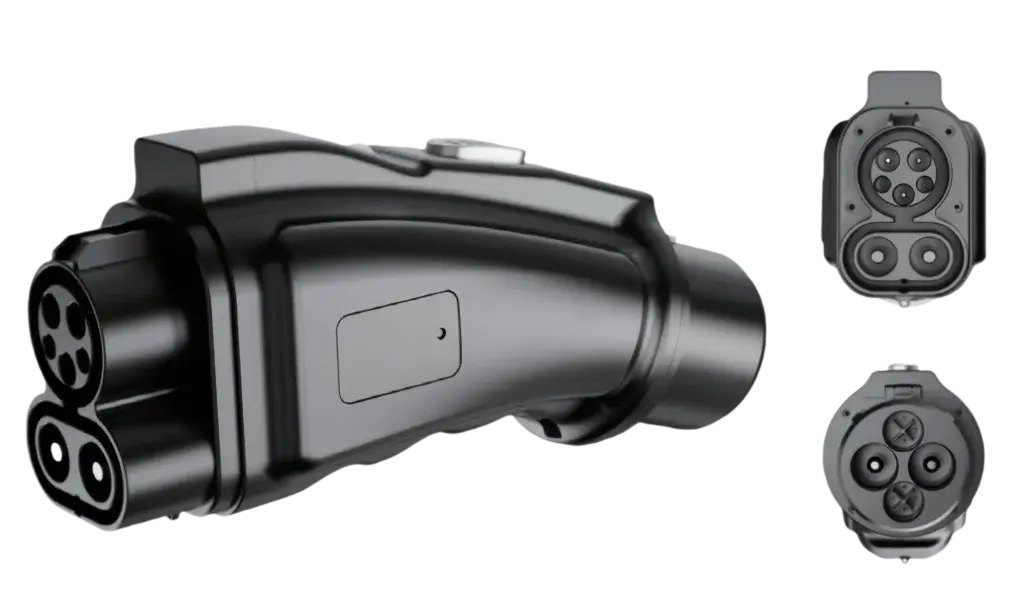
What sets your actual charging speed?
The order of authority is fixed, and it runs top-down.
- The vehicle’s own limit. The battery management system decides what the pack will accept given its state of charge and temperature. On a CHAdeMO-era vehicle, this is almost always the binding constraint.
- The station’s output. A 50 kW stall cannot deliver more than 50 kW, whatever the adapter is rated for.
- The adapter’s rating. This sets a ceiling, not a floor. A 250A, 1000V DC unit leaves wide headroom above what most CHAdeMO vehicles request, which is exactly why over-specifying here is sensible: margin at the contacts means less heat and less throttling.
Temperature and state of charge then shape the curve inside those limits. A cold pack accepts less current than a warm one, and the final portion of any charge is slower than the middle of it on nearly every electric vehicle. None of that changes because an adapter is in the circuit.
Specifications to expect
A credible CCS1 to CHAdeMO DC adapter is defined by five numbers—rated current, rated voltage, ingress protection, operating temperature, and contact material—plus weight and dimensions for storage. Everything else is construction detail.
| Paramètres | Value to look for | Pourquoi est-ce important ? |
|---|---|---|
| Courant nominal | 250A DC | Sets the ceiling for the session |
| Tension nominale | 1000V DC | Covers high-voltage DC architectures |
| Water resistance | IP54 (branché) | Rain, dust, and road spray while mated |
| Working temperature | De -30°C à +50°C | All-season operation in North American conditions |
| Outer shell | Thermoplastic, impact resistant | Survives handling and drops |
| Conducting pin | Alliage de cuivre, plaqué argent | Low contact resistance under high current |
| Poids net | 1,84 kg | Practical to keep in the vehicle |
| Dimensions | 289 x 95 x 151 mm | Fits a boot compartment or case |
| Personnalisation | Color, logo, packaging | Retail-ready for channel partners |
Read the rows in that order, and the priorities become clear. Rated current and voltage define what the part is capable of. IP54 applies while the connection is mated, not while the connectors sit open in a bag, so it is a claim about the session rather than about storage. Working temperature is a regional question, and the range above covers what a vehicle will realistically see across the continent. Weight and dimensions decide whether the adapter rides along on road trips or stays in a workshop drawer. Contact plating decides how contact resistance behaves after a few hundred mating cycles, which is where cheap parts show their age.
How to choose the right one
Work through six checks in order: vehicle inlet and protocol version, rated parameters against the stations you actually use, safety certification and test evidence, thermal and locking design, controller power source and support, and then customization and packaging if you resell.
- Confirm the vehicle side. CHAdeMO inlet, and which protocol version the vehicle implements. Older vehicles implement earlier revisions with lower limits, and the adapter has to speak them.
- Match the rated parameters to real stations. Check the CCS1 stalls on the routes or sites in question, then confirm the adapter’s rating sits above them.
- Ask for certification and test evidence. CE marking, insulation, high-potential test records, and any third-party safety listing the supplier holds.
- Inspect the thermal and locking design. Temperature sensing at the contacts, current throttling, and a latch that prevents disconnection under load.
- Settle the controller power source and support. Station-powered or internal cell, and whether the supplier can service or replace units rather than leaving them as disposable parts.
- Handle commercial requirements last. Color, logo, packaging, and documentation, which are what make the part sellable rather than merely functional.
If a fleet is not uniformly CHAdeMO, it is worth reviewing the rest of the adaptateur de charge range before settling on a single part, because CCS1, CCS2, and NACS combinations frequently appear on the same vehicle list, and buying them separately fragments spares and support.
B2B checks before you order
- Ask for a test record per batch, not per model, and confirm the sample you receive matches it.
- Confirm labelling and documentation language for your destination market.
- Get warranty terms and the replacement path in writing, including who pays return freight.
- Check whether the controller can be serviced or updated and how.
- If you resell, confirm neutral packaging and branding options up front rather than after the first order.
Safety, installation, and care
Seat both connections fully, never disconnect under load, inspect the part before every use, and stop using it at the first sign of damage. Those four rules cover the great majority of failures that occur in the field.
Do:
- Push each connection until it latches, then tug gently to confirm it is seated.
- End the session at the station or from the vehicle before separating anything.
- Wipe the connectors dry before storage and keep the protective caps on.
- Check contacts for discolouration, pitting, or loosened pins as part of routine vehicle checks.
Do not:
- Attempt to separate the adapter while current is flowing.
- Use it at an AC post or at a stall offering only CCS2 or NACS.
- Use a damaged, cracked, or wet unit, or one with exposed wiring.
- Leave the part under tension from a hanging cable or coiled tightly enough to stress the housing.
Store it cool and dry, out of direct sunlight, and away from the extremes of a vehicle that sits in the open all year. Between uses, a case is worth the trouble, because dust in a connector becomes contact resistance, and contact resistance becomes heat.
One last point to be direct about: this class of adapter is a third-party accessory rather than a manufacturer-supplied part. It is widely used and it works, but it carries the usual caveats of third-party hardware. Buy from a supplier who can show testing, who answers technical questions about protocol versions, and who will still be reachable when a charging network updates its firmware.
FAQ
Does a CCS1 to CHAdeMO adapter work at NACS or proprietary fast charging networks?
No. The adapter’s charging side is CCS1, which matches an SAE J1772 combo DC connector. NACS stalls present a J3400 connector instead, and there is no equivalent adapter path from NACS to CHAdeMO. A CHAdeMO vehicle therefore needs a stall that offers either a native CHAdeMO cable or a CCS1 DC cable.
How fast will my vehicle actually charge with the adapter?
The vehicle decides, not the adapter. Most CHAdeMO-era packs request a fraction of the adapter’s 250A ceiling, so the adapter is rarely the limiting factor. What you will notice instead is station output and pack condition: a lower-power stall charges slowly, a cold pack accepts less current, and the last part of any charge takes longer than the middle. If a session is slower than expected, compare the stall rating and the state of charge before suspecting the adapter.
Can I use the same adapter at a CCS2 station or for AC charging?
No on both counts. CCS1 and CCS2 are physically different connectors serving different regions, so a CCS1 adapter will not mate with a CCS2 cable. And the adapter is a DC fast charging part; it has no role in AC charging, which on a CHAdeMO vehicle runs through a separate inlet with its own cable.