En China, los vehículos eléctricos utilizan la interfaz de CA GB/T 20234.2, mientras que en la mayor parte de Europa se emplea el conector de tipo 2 definido por la norma IEC 62196-2. A medida que crece el comercio de vehículos entre estas regiones y cada vez más conductores cruzan las fronteras, estos dos tipos de conectores siguen coincidiendo en el mismo punto de recarga. La incompatibilidad no es meramente estética: las clavijas, el tipo de conector y el protocolo de comunicación difieren, por lo que un coche europeo no puede simplemente recargarse en una estación china, y lo mismo ocurre a la inversa.
Un adaptador de GB/T a Tipo 2 es un accesorio de carga de CA que permite a un vehículo de Tipo 2, cuya interfaz está normalizada según la norma IEC 62196-2 Según las especificaciones, se alimenta de una estación de recarga de CA conforme a la norma GB/T, o al revés cuando la unidad está montada al revés. Sirve de puente entre las dos normas regionales, tanto a nivel eléctrico como físico, pero solo para la corriente alterna, nunca para la recarga rápida en corriente continua.
En los apartados siguientes se explica para qué sirve el adaptador, por qué los dos estándares no pueden conectarse por sí solos, qué prestaciones cabe esperar y en qué situaciones resulta útil el adaptador.
¿Qué es un adaptador de GBT a tipo 2?
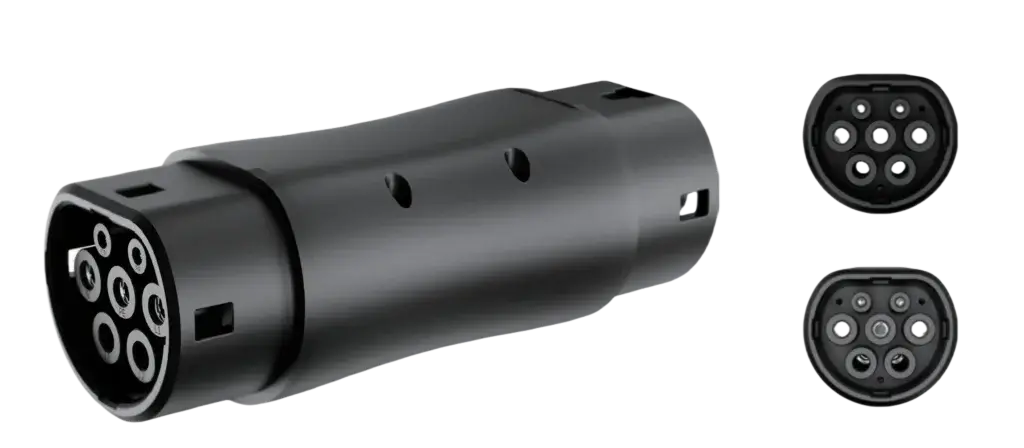
Se trata de un convertidor de interfaz de CA pasivo diseñado para un único sentido de flujo: desde una estación de recarga GB/T en el lado del suministro hasta una toma de tipo 2 en el lado del vehículo. La carcasa incorpora la toma GB/T en un extremo y el enchufe de tipo 2 en el otro, sin componentes electrónicos activos que modifiquen el modo de recarga.
El adaptador existe porque los dos conectores tienen un aspecto muy similar, pero son diferentes desde el punto de vista eléctrico. Un adaptador de GBT a tipo 2 para vehículos eléctricos pertenece a la familia más amplia de adaptadores de carga Está diseñado para conectar enchufes de estándares diferentes y suele utilizarse junto con otros accesorios de recarga compatibles con la recarga de vehículos eléctricos entre distintos estándares. Deja pasar directamente la corriente alterna, el neutro, la toma de tierra de protección y las señales de control, de modo que el cargador integrado del coche y la estación pueden establecer su comunicación habitual. No aumenta la tensión, no añade corriente ni convierte la corriente continua en alterna. La mayoría de las unidades tienen una capacidad nominal de 32 A y se mantienen dentro de los límites de corriente alterna de ambos estándares.
De GBT a tipo 2 frente a de tipo 2 a GBT
Los nombres indican la dirección, y la dirección determina qué dispositivo necesitas. Un adaptador de GB/T a Tipo 2 conecta una estación GB/T a un coche de Tipo 2. Un adaptador de CA de Tipo 2 a GB/T hace lo contrario: permite que un vehículo GB/T se recargue en una estación de Tipo 2. Ambos son solo de CA, tienen los mismos límites de corriente, pero los extremos del enchufe y la toma están invertidos. Si compras el adaptador con la dirección incorrecta, no encajará en ninguno de los dos extremos, por lo que lo primero que hay que comprobar antes de la compra es siempre el estándar de la estación y la toma del vehículo.
¿Qué es un conector de tipo 2?
El conector de tipo 2 es la interfaz de recarga de CA estandarizada según la especificación IEC 62196-2 y adoptada como enchufe oficial de corriente alterna para la Unión Europea. Cuenta con siete contactos: tres líneas de fase, un neutro, una toma de tierra de protección y dos pines de señalización para control y proximidad. Admite la recarga monofásica en el hogar y la recarga trifásica a mayor potencia, y es compatible con la gran mayoría de los vehículos eléctricos del mercado europeo.
¿En qué consiste la norma GB/T 20234.2?
La norma GB/T 20234.2 es la norma nacional china para la recarga de CA. A simple vista, se parece al Tipo 2, con un cuerpo redondo y una parte superior plana, pero la disposición de las clavijas es simétrica y el lado del vehículo utiliza un conector de sexo opuesto. Las señales de control también siguen un protocolo diferente. Debido a estas diferencias, un enchufe de Tipo 2 no encaja físicamente en una toma GB/T, y esa es precisamente la razón por la que se necesita un adaptador específico en lugar de un simple manguito mecánico.
Por qué los dos estándares son incompatibles sin un adaptador
Los conectores comparten un parecido familiar, pero se desarrollaron por separado y se diseñaron siguiendo normas mecánicas y eléctricas diferentes. Una conexión directa falla en tres aspectos: las clavijas no encajan, los sexos del conector macho y la toma están invertidos, y el lenguaje de comunicación no es el mismo. Un adaptador resuelve esta incompatibilidad reconstruyendo la interfaz en ambos extremos, al tiempo que mantiene la continuidad de la corriente alterna.
| Atributo | GB/T 20234.2 (China AC) | Tipo 2 (IEC 62196-2, CA de Europa) |
| Región | China continental | Europa y muchos otros mercados |
| Tipo de carga | Solo CA (norma de CC independiente) | Solo CA (la CC la gestiona el CCS2) |
| Tensión típica | 220 V monofásico / 380 V trifásico | 230 V monofásico / 400 V trifásico |
| Potencia máxima típica de CA | Alrededor de 7 kW monofásico / 22 kW trifásico | Alrededor de 7,4 kW en monofásico / de 22 a 43 kW en trifásico |
| Tipo de conector | Toma hembra del vehículo, toma macho de la estación | Toma de vehículo macho, estación hembra |
| Señalización de control | Protocolo GB/T | Protocolo de control PWM-piloto |
forma del conector y configuración de los pines
Ambos conectores cuentan con siete posiciones de contacto, aunque su disposición es simétrica entre sí. Los pines de tierra de protección, fase, neutro y señal se encuentran en lugares diferentes, y la toma del vehículo en un coche chino es hembra, mientras que en un coche europeo es macho. Esa diferencia por sí sola impide una conexión directa. El adaptador reconfigura cada extremo con la forma correcta para que tanto el cable de la estación como la toma del coche encajen y se bloqueen tal y como están diseñados.
señalización de control y comunicación
Más allá del material metálico, los dos estándares utilizan protocolos de control diferentes. El tipo 2 emplea el método de control PWM para negociar la corriente disponible y confirmar una conexión segura. La norma GB/T utiliza su propia secuencia de señalización. El adaptador debe transmitir estas señales de forma que ambas partes las entiendan; de lo contrario, la estación se negará a ponerse en marcha. Por eso los adaptadores están diseñados para su uso con CA y no pueden utilizarse en una sesión de carga rápida de CC, donde la comunicación y la configuración de los pines difieren mucho más.
Especificaciones técnicas y potencias nominales
La mayoría de los adaptadores de GBT a tipo 2 disponibles en el mercado admiten una corriente continua de 32 A. Esto supone unos 7,4 kW en monofásico y unos 22 kW en trifásico, lo que cubre las necesidades diarias de recarga de CA de casi todos los vehículos eléctricos de pasajeros. Existen versiones con mayor intensidad, pero 32 A es la intensidad habitual y ampliamente compatible.
| Parámetro | Valor típico |
| Corriente nominal | 32 A (monofásico y trifásico) |
| Potencia nominal | 7,4 kW (monofásico) / 22 kW (trifásico) |
| Tensión nominal | 250 V (monofásica) / 400 V (trifásica) CA |
| Temperatura de funcionamiento | -30°C a +50°C |
| Protección contra la entrada de elementos | IP54 tras el acoplamiento |
| Vida útil mecánica | Más de 10 000 ciclos de conexión |
| Certificación | Marcado CE para uso en el mercado europeo |
Carga con corriente alterna monofásica frente a trifásica
La recarga monofásica utiliza un solo cable con corriente y proporciona hasta unos 7,4 kW, lo que resulta adecuado para las tomas de corriente domésticas y las recargas nocturnas. La recarga trifásica utiliza las tres fases y alcanza unos 22 kW, lo que reduce el tiempo de recarga siempre que tanto la red eléctrica como el vehículo lo permitan. Normalmente, el mismo adaptador sirve para ambos tipos; la potencia real depende de lo que ofrezca la estación de recarga y de lo que admita el cargador integrado del vehículo.
límites de corriente, tensión y potencia
La seguridad del adaptador depende exclusivamente de los valores para los que está diseñado. Si se superan los 32 A en una unidad de 32 A, se corre el riesgo de que se produzcan sobrecalentamientos en los contactos. La salida de la estación debe mantenerse dentro de los límites nominales del adaptador, y la tensión de alimentación debe coincidir con los niveles de CA que establecen ambas normas. Una coincidencia correcta mantiene baja la resistencia de contacto y el aumento de temperatura dentro de los límites establecidos, incluso tras sesiones repetidas.
Cuando se utilizan adaptadores de GBT a tipo 2
El adaptador resulta indispensable allí donde conviven infraestructuras GB/T y vehículos de tipo 2. Esa situación es más habitual de lo que parece: los coches importados, los exportados y las flotas mixtas la provocan. En cada caso, el adaptador evita tener que desmontar equipos que funcionan correctamente solo para poder utilizar un enchufe diferente.
flotas transfronterizas y exportación de vehículos
Un vehículo eléctrico europeo importado a China, o un modelo fabricado en China destinado a la exportación, suele llegar a un mercado en el que los cargadores públicos y de las estaciones de servicio utilizan el otro estándar. El adaptador permite que el vehículo se recargue en las estaciones de CA locales sin necesidad de modificaciones. Para las empresas que desplazan vehículos de una región a otra, esto elimina una barrera práctica y permite que un mismo vehículo se pueda utilizar a ambos lados de la frontera.
redes de recarga y parques de vehículos con estándares mixtos
Las estaciones de servicio, los lugares de trabajo y las instalaciones públicas que admiten ambos estándares se benefician de disponer de un pequeño stock de adaptadores en lugar de duplicar el hardware. Cuando una instalación ya cuenta con puntos de recarga GB/T de CA, la incorporación de adaptadores de tipo 2 a GB/T permite la recarga de vehículos de tipo 2; cuando la instalación es de tipo 2, los adaptadores inversos permiten la recarga de vehículos GB/T. El resultado es una única red que da servicio a más vehículos con un menor desembolso de capital.
Cómo elegir el adaptador adecuado
A la hora de elegir, lo fundamental es que la orientación coincida, asegurarse de que solo se utilice en modo CA y respetar la intensidad nominal. Una comprobación minuciosa antes de la compra evita el fallo más habitual: comprar un adaptador que esté mal orientado o que requiera un modo de carga que la estación no ofrece.
Confírmalo antes de comprarlo.
Comprueba cuatro cosas. En primer lugar, identifica el estándar de entrada del vehículo y el estándar de salida de la estación. En segundo lugar, comprueba que la orientación del adaptador coincida con ese par. En tercer lugar, verifica que la estación sea de carga rápida de CA y no de CC. En cuarto lugar, asegúrate de que la corriente de la estación no supere el amperaje nominal del adaptador. Si la estación utiliza un software propio que bloquea los cables de terceros, es posible que se rechace incluso un adaptador adecuado.
errores habituales en materia de compatibilidad
El primer error es dar por sentado que un adaptador funciona en ambos sentidos; la dirección es fija. El segundo es esperar una carga rápida de corriente continua; estos adaptadores son solo de corriente alterna. El tercero es ignorar el límite de corriente y combinar un adaptador de 32 A con una toma de salida de mayor potencia. El cuarto es considerar el adaptador como un convertidor de tensión o un convertidor estándar; se trata de un puente pasivo, no de un transformador. Ninguno de estos problemas se soluciona con un proveedor diferente, sino únicamente con las especificaciones adecuadas.
Seguridad, durabilidad y certificación
Un adaptador de sonido debe ser resistente al polvo y a las salpicaduras de agua, mantener sus prestaciones ante los cambios de temperatura y contar con la certificación necesaria para el mercado al que se destina. Las piezas mecánicas deben encajar firmemente y bloquearse, y los contactos deben permanecer fríos incluso tras un uso repetido. Para obtener más información sobre las prácticas de manipulación, almacenamiento e inspección, consulte el Guía de seguridad sobre adaptadores de recarga para vehículos eléctricos.
protección contra la entrada de partículas y rango de temperatura
La protección IP54 significa que el adaptador bloquea la mayor parte del polvo y resiste las salpicaduras de agua procedentes de cualquier dirección una vez acoplado, lo cual es suficiente para una recarga típica de CA al aire libre. El rango de funcionamiento nominal, de aproximadamente -30 °C a +50 °C, cubre la mayoría de los climas. Las carcasas están fabricadas en termoplástico resistente al calor y a los impactos, y los contactos de cobre plateados o estañados mantienen baja la resistencia, de modo que la unidad se mantiene dentro de los límites de temperatura.
certificación y cumplimiento normativo
Para su uso en el mercado europeo, el marcado CE indica que el producto cumple los requisitos pertinentes de la UE en materia de seguridad y compatibilidad electromagnética. Los compradores que operen en varias regiones deben confirmar los marcados específicos que exige su mercado. La certificación por sí sola no garantiza el rendimiento, pero constituye el filtro básico que descarta las unidades con mayor probabilidad de fallar bajo carga.
Preguntas frecuentes
Las tres preguntas que figuran a continuación van más allá del texto principal y abordan la vida útil, las normas de uso público y los límites de compatibilidad que debes conocer antes de utilizar un adaptador.
¿Se puede cargar cualquier coche de tipo 2 con un adaptador de GBT a tipo 2?
Funciona con cualquier toma de CA estándar de tipo 2, ya que el adaptador solo reconfigura la interfaz del conector y deja pasar las líneas de CA y las señales. La limitación la pone la estación, no el coche: si la toma es de CC, está bloqueada por software o tiene una intensidad nominal superior a la del adaptador, la recarga no se iniciará. El propio vehículo rara vez es el factor limitante.
¿Cuánto tiempo dura un adaptador de GBT a Tipo 2?
La vida útil se rige por los parámetros mecánicos de diseño, que suelen superar los 10 000 ciclos de conexión para los contactos. La vida útil real depende de cómo se maneje el producto, de la temperatura y de la frecuencia con la que se consuma la corriente nominal. Almacenarlo en un lugar seco, evitar que se caiga y no superar la intensidad nominal mantendrá estable la resistencia de contacto a lo largo de los años de uso.
¿Es legal utilizar un adaptador de GBT a tipo 2 en los puntos de recarga públicos?
La legalidad depende de la normativa local y del operador de la estación. El adaptador en sí mismo es un puente de interfaz de CA conforme a la normativa cuando está debidamente certificado, pero algunas redes públicas utilizan software que solo admite cables homologados. Los conductores deben consultar las condiciones del operador y la normativa regional sobre equipos antes de utilizar un adaptador en una estación pública compartida.