
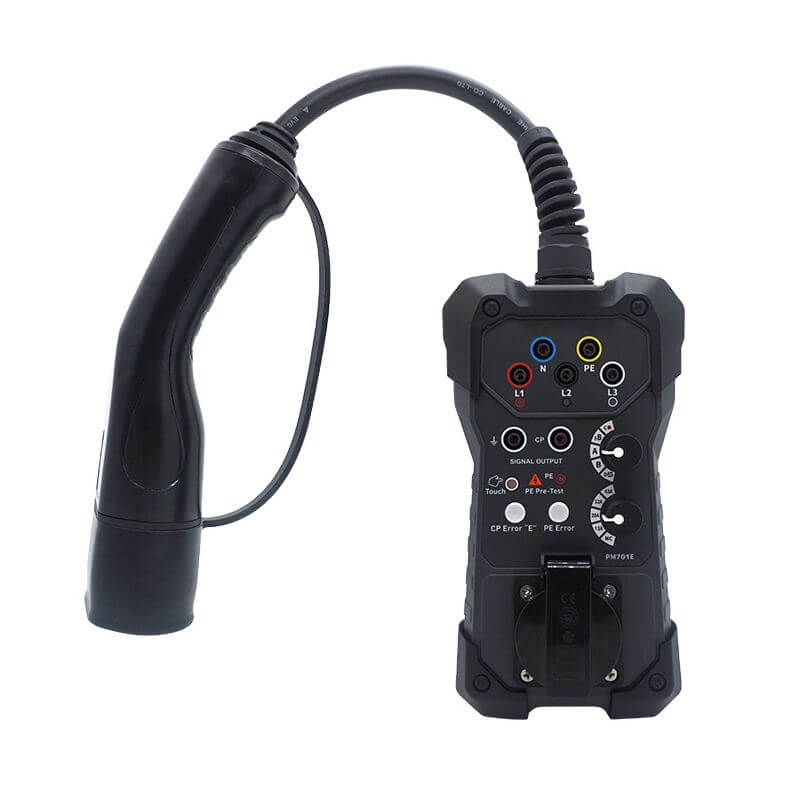
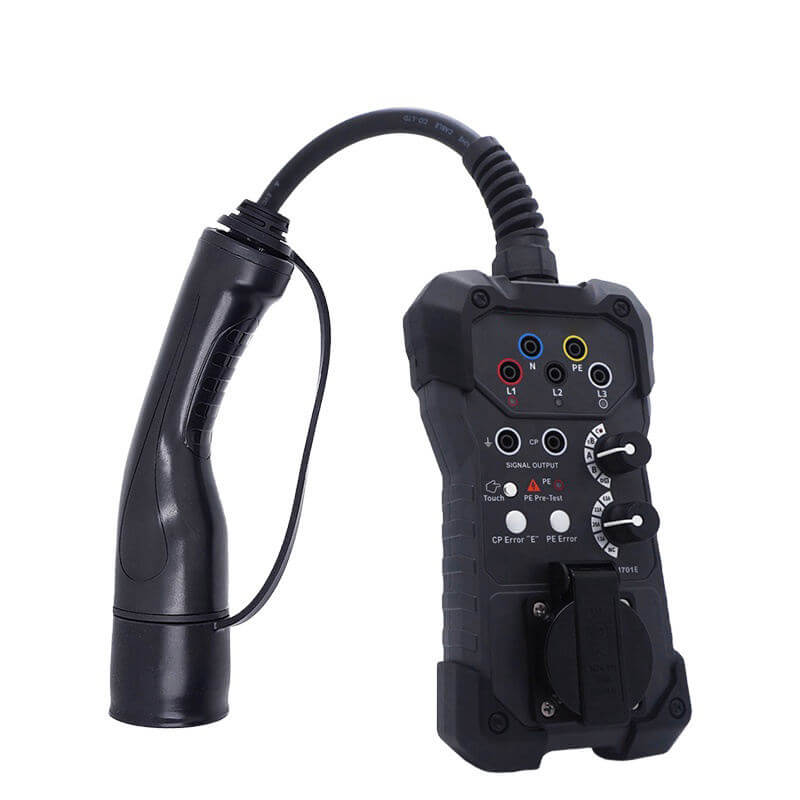
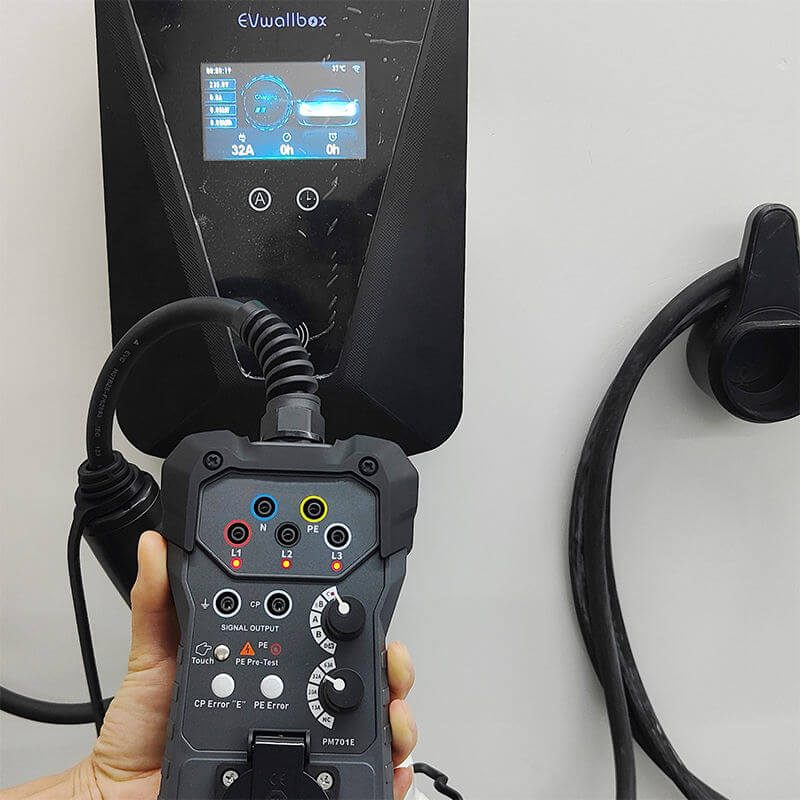
Portable EVSE Tester – Charging Station Tester (Type 1 & Type 2)
The Portable EVSE Tester is a comprehensive solution for the safety and functional testing of AC Electric Vehicle charging stations. Designed for technicians and installers, this all-in-one tool simulates various vehicle states to ensure charging points (Type 1 and Type 2) are operating correctly, safely, and in accordance with international standards.
Whether you are performing routine maintenance, troubleshooting a faulty station, or conducting final installation inspections, this rugged, handheld simulator provides immediate feedback on CP (Control Pilot) and PP (Proximity Pilot) states, leakage protection, and wiring integrity.
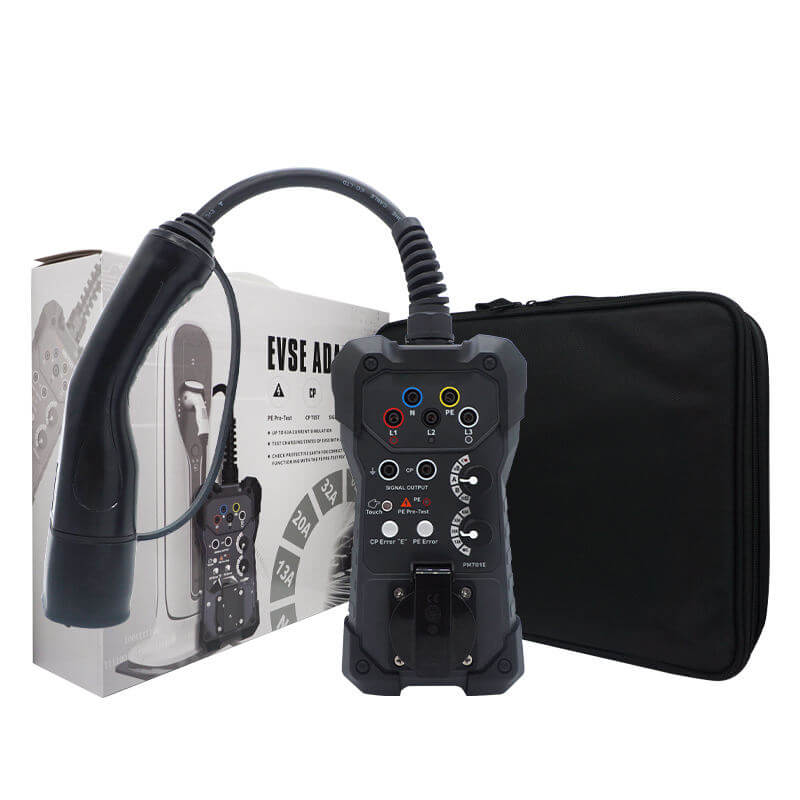
Key Features of Portable EVSE Tester (Type 1 & Type 2)
- Complete Control Pilot (CP) Analysis: The Portable EVSE tester allows technicians to cycle through Control Pilot manually to verify that the EVSE (Electric Vehicle Supply Equipment) responds correctly. By switching between states A through D, you can verify if the station correctly locks the cable and initiates the charging sequence.
- Proximity Pilot (PP) Simulation: Verify that the charging station correctly detects the current-carrying capacity of the charging cable. The rotary switch allows for simulation of various cable ratings (13A to 63A) to ensure the station limits current as required.
- Safety & Error Testing: Simulate a "Diode Short" or a "CP Error E" to confirm the charging station immediately shuts down power. This is a critical safety test to ensure the EVSE will protect a vehicle's onboard charger in the event of a component failure.
Why Choose Portable EVSE Tester (Type 1 & Type 2)
Unlike basic multimeters, this specialized simulator interacts with the charging station’s internal logic. It eliminates the need to bring an actual Electric Vehicle to a site to verify a new installation, saving time, reducing costs, and ensuring that every station you install is safe for public or private use.
Compatibilità universale
Supports both Type 1 (SAE J1772) and Type 2 (IEC 62196-2) charging interfaces.
Vehicle State Simulation
Easily simulate vehicle states: A (Disconnected), B (Connected), C (Charging), and D (Charging with Ventilation).
Safety First
Includes a PE (Protective Earth) pre-test and error simulation (CP Error "E" and Diode Short) to ensure the station reacts correctly to fault conditions.
Leakage & RCD Testing
Built-in capability to test RCD/GFCI trip functionality to ensure user safety against electrical shock.
Real-time Feedback
Clear digital display provides instant readings of voltage, current, and pilot signal status.
Portable & Rugged
Compact, handheld design with a high-durability housing, perfect for field use in various weather conditions.
Parameter of Portable EVSE Tester (Type 1 & Type 2)
| Caratteristica | Specifiche |
|---|---|
| Tensione di ingresso | AC 110V / 230V (Single Phase) |
| Frequenza | 50Hz / 60Hz |
| Test Connector | Type 2 (Socket/Plug) & Type 1 (Adapter) |
| CP States Simulation | A, B, C, D |
| PP State Simulation | Open, 13A, 20A, 32A, 63A |
| Fault Simulation | CP Error 'E', Diode Short |
| RCD Test | 30mA (standard trip test) |
| Temperatura di esercizio | -10 °C to 40 °C (14 °F to 104 °F) |
| Ingress Protection | IP54 (Dust and Splash Proof) |
| Weight | Approx. 1.2 kg (with cables) |
Centro assistenza
FAQ
Q: What types of charging stations can this portable EVSE tester check?
A: This EVSE Tester offers universal compatibility, supporting both major global AC charging standards: Type 1 (SAE J1772, common in North America and Japan) and Type 2 (IEC 62196-2, standard in Europe and many other regions). One tool covers most public, commercial, and residential AC charging points.
Q: What key safety functions does this portable EVSE tester verify?
A: This comprehensive EV charger tester is built for safety validation. It performs critical tests, including:
Protective Earth (PE) Continuity: Checks for a proper ground connection.
RCD/GFCI Trip Testing: Verifies that the station’s residual-current device operates correctly to prevent electric shock.
Fault Simulation: Actively simulates critical errors like a “Diode Short” or “CP Error E” to confirm the station shuts down power immediately as required by safety standards.
Q: Can EVSE Tester test the communication between the charger and a vehicle?
A: Absolutely. This is a core function. The portable EVSE tester simulates all standard Control Pilot (CP) states (A, B, C, D) to verify that the station correctly manages the connection handshake, starts/stops charging, and communicates ventilation requirements. It also simulates Proximity Pilot (PP) signals to test if the station correctly detects and respects the cable’s current rating.
Q: Is this Portable EVSE Tester suitable for field use and harsh environments?
A: Yes. Designed as a portable EVSE Tester, it features a compact, rugged, and handheld design with a durable housing. It is built to withstand the demands of daily field use by technicians in various weather and site conditions.
Q: Who is the ideal user for this Portable EVSE Tester (Type 1 & Type 2)?
A: This EVSE Tester is an essential tool for:
EV Charging Station Installers & Electricians
Facility & Fleet Maintenance Technicians
Service and Commissioning Engineers
Quality Assurance / Compliance Inspectors
Anyone responsible for the safe installation, functionality, and ongoing reliability of AC charging infrastructure will benefit from this portable EVSE tester.
Guide di cui potreste aver bisogno
Perché non tutti i cavi di ricarica EV funzionano con tutti i caricabatterie
I veicoli elettrici (EV) non sono più un'innovazione marginale: sono diventati mainstream. Con l'arrivo di milioni di nuovi veicoli elettrici sulle strade nel 2024 e 2025, una delle domande più frequenti da parte dei nuovi acquirenti è la seguente
Perché le aziende hanno ancora bisogno di caricatori portatili EV nell'era dei supercaricatori
Nel luglio 2025, il gigante cinese della mobilità DiDi ha presentato un rivoluzionario supercaricatore per veicoli elettrici da 1600 kW, stabilendo un nuovo punto di riferimento nella tecnologia di ricarica dei veicoli elettrici. Con la capacità di ricaricare i veicoli elettrici compatibili in un tempo di
Come scegliere un caricatore portatile EV affidabile: una guida per gli acquirenti B2B
In una recente intervista, Harry Bajaj, fondatore dell'azienda tecnologica EV Mobec Innovation, ha sottolineato l'urgente necessità di affrontare l'"ansia da autonomia" attraverso soluzioni di ricarica flessibili e mobili. La sua campagna #PledgeForChange chiama


 Italian
  English
  Spanish
  Portuguese
  French
  Russian
  German